-
-
-
China Daily E-paper
Raymond Zhou
The fourth dimension
By Raymond Zhou (China Daily)
Updated: 2010-01-08 07:40
 |
Large Medium Small |
There are layers of meanings to the best films, novels and plays, and we find our own points of significance in these works by cultural "re-imagining".
Director James Cameron's Avatar is sweeping cinemas around the globe like a tsunami. Here, you have to book in advance or wait in long lines - and the only shows with tickets available are for odd hours.

Groundbreaking special effects aside, the 3D movie has the themes of fighting colonialism, indiscriminate use of military forces and interracial relationships. But the moment the giant bulldozer appeared on screen, I had an "aha" epiphany: This movie is about today's China, or, more accurately, there is a specific Chinese interpretation.
Avatar is, or could be seen as, a parable about the fight of ordinary people against the all-engulfing greed of real estate developers. In Chinese parlance, the Na'vi would be called "nail houses", people who refuse to give up their legally owned properties. They protect their rights and houses - or trees in this case - and stick out like nails amid a field of debris.
I'm sure Cameron did not get his inspiration from the plight of Chinese "nails". He was obviously referring to the wars George W Bush launched in the Middle East. But I'm not the only Chinese person who "twisted" this tale to fit our paradigm.
For example, when the Na'vi shoot arrows at the heavy machinery that crushes everything in its path, the scene that instantly come to my mind was the Shanghai woman, surnamed Pan, who used a homemade Molotov cocktail to thwart the rumbling bulldozers - albeit in vain. When the Na'vi hold a vigil reminiscent of the Zhang Yimou-directed Olympic Opening Ceremony, the sense of foreboding is so pervasive that I cannot help but think of Tang Fuzhen, the Chengdu woman who resorted to self-immolation to protest against "forced eviction".
I wouldn't be surprised if the authorities put a stop to the screening of this massive blockbuster - when too many people, as I do, read into it a connection with a reality that's too close for comfort. But they cannot blame Cameron for "inciting unrest" among a restive populace unable to hold on to their rights of abode.
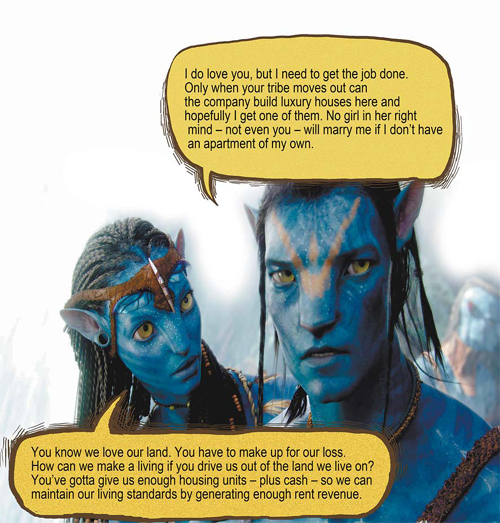
Such is the nature of cross-cultural message relays. People of one culture read into the works of another culture meanings unintended. With reasonable arguments, these interpretations can add layers to the work and bring relevance to a new audience. It is quite different from a failure to understand the author's original meaning. Most educated Chinese get the message Cameron embedded in the fantasy tale, but it does not resonate with us as much as the developers-vs-landowner angle.
In my line of work, I encounter these kinds of problems every day. I am a consultant for several organizations in the business of importing foreign books, movies, TV shows and events. Apart from the factor of name recognition, I ask myself and those who seek my counsel: "Does it have a Chinese angle?" "Can the target audience relate to the issues?"
One work that clicked with Beijing audiences was Jane Eyre. Wildly popular in the late 1970s and early 1980s when China opened its doors to Western influence, the classic story about a young governess and her rocky romance with her employer faded on dusty shelves when foreign books were no longer taboo.
Last year, the National Center for the Performing Arts had two runs of Jane Eyre. It dawned on me this tale really strikes home today. Jane is not beautiful, she is not rich, the man who is willing to marry her has a castle. Yet she walks away from the wedding because he has a wife.
Now, contrast it with Dwelling Narrowness, a recent TV show so popular it was banned - a woman uses her beauty to become a concubine for the sole purpose of getting a decent apartment. What would she think of Jane Eyre? Nuts, probably. Edward Rochester could have got a full house of concubines.
You see, Jane Eyre is poignant because it is a perfect counterpoint to Dwelling Narrowness and the harsh reality it depicts. In both Avatar and Jane Eyre, you can detect the real issues that grip China - an emerging middle-class, made up of those in their late 20s and early 30s, blocked out from affordable housing, and an army of property owners in a losing battle against developers and the interests they represent. More irony: The latter group is robbed so that more houses can be built and the former gourp has to buy them at prices so high they are essentially robbed, for life.
With house prices skyrocketing across the country, housing is such a big problem that even a domestic release was reinterpreted through this prism. The Founding of a Republic, an epic made to celebrate the 60th anniversary of New China, was ruthlessly dissected by irreverent young writer Han Han. He pointed out that Madame Soong Ching-ling's support of the Communist Party hinged on her ability to retain her mansion in downtown Shanghai, a point partly supported by a line in the movie that a Communist leader said she could keep her house.
When I mounted The Sound of Music in Beijing 12 years ago, one of my concerns was the seven kids.
China has a family planning policy. Most urban families have only one kid. Would they accept one with seven? Would it be outlandish?
No, I was not engaged in self-censorship. I was zooming in on those discrepancies the audience may have with the work. Even without the policy, most Chinese families would not want more than two kids. A horde of siblings is not something urban children - our target audience - take for granted.
Fortunately, the musical does not focus on sibling dynamics. The seven kids act no differently from schoolmates. Besides, the plot was already so familiar many probably did not even think of it. But it was a legitimate point. Most sitcom families in America have three children. How can you map out storylines in a Chinese television show centered around a family?
Home with Kids, a hit sitcom in China, tackled this dilemma with ingenuity. The wife had a previous marriage, so she has a son. The husband has a daughter from a previous marriage and he also has a younger son, who was born in the United States. So, it is still a family of three kids, all born legally.
A family sitcom with one child would be a daunting task for the scriptwriters.
Most people grow up in one culture and have trained themselves to look at things from a certain angle. Their way of thinking and doing things is what makes culture unique.
But to broaden the appeal of a cultural work, it is often necessary to tone down that specificity so that people from other cultures may search and find their own relevancies. That means distilling the complexities and uniqueness to a few broad issues. Hollywood is a master at that. It often dumbs down too much, leaving a few cut-and-dried cliches.
Avatar may not have much depth, but it inadvertently hits a nerve in a country where the bulldozer is a sign of both progress and threat.
(China Daily 01/08/2010 page18)