-
-
-
China Daily E-paper
Raymond Zhou
Shut up, potty-mouths
By Raymond Zhou (China Daily)
Updated: 2010-02-05 07:59
 |
Large Medium Small |
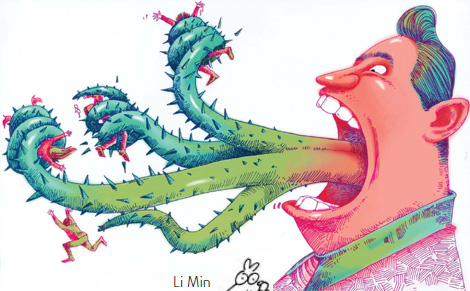
Verbal violence permeates China's Internet and beyond. It is fuelled by rampant frustrations and a lack of tradition for rational discourse.
Our skyline may be growing more spectacular by the day, but a dirty mouth characterizes China's face. Most Chinese people are polite and restrained in their personal interactions, but when the situation is impersonal, the attacks are really personal.

Let's start at the bottom rung of the social echelon: The anonymous netizens who leave comments on online forums. Whenever a report comes out about, say, a serial killer or rapist in a certain province, they curse everyone in that province as if they are all responsible for the criminal's heinous crimes. They don't seem to realize that perverts like this exist everywhere. For a while, places like Henan were so stigmatized people from the province dared not reveal their hometowns when seeking jobs elsewhere.
Then come bloggers and columnists, a group to which I belong. If we write something positive, we'll be suspected of shilling. If we give a nuanced analysis, editors won't give it a snappy and attention-grabbing headline; and few readers will have the patience to read it through. The most popular articles are invariably negative, denouncing in the strongest possible terms everything from social phenomena to a movie. A Simple Noodle Story or Confucius may not be good movies, but they do not deserve the kind of viciousness poured on them by self-claimed critics. The Treasure Hunt and The Storm Warriors are far worse in terms of quality, yet they were spared the blitzkrieg of poison.
The reason is simple: People reserve their venom for the powers-that-be. They get vicarious gratification by virtually toppling powerful figureheads and empowering themselves in the process.
But they are selective. They cannot target political power, which they know will get them into trouble. The super-wealthy have a way of hiding from public scrutiny. They have meticulously cultivated a clean image, and only a few, such as Ren Zhiqiang of the real estate industry, dare to position themselves as an unashamed symbol of business interests and thus turn themselves into online cannon fodder.
The ideal targets are cultural celebrities and minor officials. They become fair game by virtue of their ubiquity, or inability to defend themselves. To make matters worse, they often act like despots of independent dominions, not accountable to either the higher-ups or the hoi polloi. Some of them may indeed come under the official umbrella of protection, but most are chagrined to find their connections are not strong enough, leaving them exposed when it comes to dodging bullets.
China is gripped by hatred, which is almost like an out-of-control machine-gun, firing indiscriminately at any moving target. We hate Western imperialists who blithely engage in activities that make us unhappy. We hate officials, big or small, who are corrupt to the bone and get all the perks and yet never hide their contempt or condescension for us. We hate celebrities who deign to care for us but instead care only about whether we buy their products. We hate our elders because they have taken our jobs and driven up housing prices, depriving us of a decent future. We hate the young because they are so preoccupied with trivial pursuits such as games, virtual friends and movie stars. We hate those richer than us and those poorer than us. We hate our peers because they always seem to get ahead of us. And we hate ourselves because our relentless drive for a better life seems to go nowhere.
The 2008 Sichuan earthquake, calamitous and heartrending as it was, brought out something good - compassion. It served as the perfect antidote to an age of apathy and cynicism. But wasn't that too high a price? Isn't compassion a natural human quality?
Granted, there are a lot of things that deserve our revulsion. We spat upon the official who sexually harassed Deng Yujiao, the young woman who thwarted his advances and killed him in self-defense. We detested the official who flaunted his ill-gotten fortune by wearing an expensive watch and smoking expensive cigarettes. There are so many injustices in our society that any sensible person can flare up. Yet, our action should not be driven simply by indignation. It should be the pursuit of justice that goads us.
Most of all, we should refrain from the dirty language that surrounds these "public campaigns". I don't see much social benefit in swearing like a sailor. It only debases a public discourse. Those who resort to virulent criticisms may think that's the best way to incite action or an official response. As a matter of fact, language has a way of losing its bite. If you immoderately use high-sounding words, pretty soon people will become numb to them.
The anonymous Internet serves as a sewer where people on pedestals become punch-bags and are cast down. If the system changes to real-name registration, the platform will be cleaner but its function for letting off steam will be limited. It'll be sometime before the online public learns how to conduct a rational debate without recourse to defamation.
Another reason for this profanity-ridden convention is the influence of the authorities. The criticism sessions of a bygone era may be a receding memory, but they still haunt us like an apparition. Traces of verbal violence pop up everywhere, such as the slogans on rural roadsides. One that promotes family planning goes like this: "Rather we have a pool of blood than exceed the birth quota by one!" Sadistic, isn't it?
The irony of family planning slogans is the ingenuity. It seems the government has not set a parameter for the language used. Local cadres have to come up with their own lines. And you can gauge the seriousness of the policy by the harshness of the wording.
Most official slogans are so replete with clichs they will not get this kind of close examination. Yet the presentation still retains the exaggerated form of the past era. Not long ago, some public buildings in Shanghai were draped in such old-time garishness. They were like a wild man transported in time from 40 years ago - wielding a machete in a house of glass. It totally spoiled the forward-looking image the city had been trying to cultivate for itself.
Like urbanites elsewhere, ordinary Shanghainese are also guilty of insulting rural visitors and migrant workers. However, people of this metropolis do not fall prey to the same overused vulgarities. A recent incident is a perfect illustration: A local radio-show host received a text message from a listener who complained about the Shanghai dialect. In response, the host said: "Please bundle yourself into a ball and roll out of the city you despise."
He got a lot of negative feedback. The reasoning is, he is a public figure so he should be held to a higher standard. For me, this euphemism for "Get the hell out of my city!" is the smartest slur I have heard in public. To quote a line from a movie, it at least has the "input of intelligence".
(China Daily 02/05/2010 page18)