Op-Ed Contributors
Low on carbon, high on development
By Arthur Hanson (China Daily)
Updated: 2010-03-18 07:48
 |
Large Medium Small |
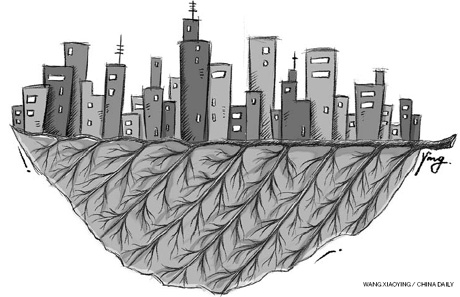
Cities should be the prime focus for low carbon development. Eventually they will house most of the world's population and therefore whatever happens in cities will, more generally, have a huge impact on low carbon energy use. Cities often provide the stimulus for innovation and improved living conditions, and become the source of most consumption.
These factors can provide the demand side for improved standards in transportation and building quality and efficiency for linking health, environment and quality of life concerns that form an essential part of the low carbon message, and for good planning and design.
| ||||


Many cities in the world lie between these extremes, and therefore offer considerable potential for development - or, in many cases, redevelopment to become sustainable, low carbon habitats.
China has some remarkable advantages in this area, though it is not without its share of difficulties. The first challenge for China is its rapid rate of urbanization and huge absolute numbers. A study conducted by China Council of International Cooperation on Environment and Development (CCICED) shows 300 million farmers will move to cities in the next three decades.
The second problem is the huge demand for material inputs. Almost everything, from steel girders and cement to aluminum and other products needed to build urban infrastructure and houses is produced with a high carbon footprint. And though this problem can be tackled to some extent, there is a high embedded carbon level in China's urban development.
The third difficulty China faces is its commitment to private vehicle ownership. One look at Beijing or Shanghai is enough to understand the magnitude of the problem. And to get an idea about how grave the problem would be 10 or 20 years from now, take the number of vehicles, roads being constructed and kilometers driven at present and extrapolate them to the total number of large and small cities in other parts of China during that period.
Finally, the emerging energy consumption patterns pose a challenge. CCICED's task force on urbanization found that only a small percentage of China's urban population now consumes energy and possibly many other resources at a level similar to people in Western cities. If this percentage grows to become the majority, then the low carbon goals may be very difficult to achieve.
Another significant challenge is the urgent need for strict enforcement of standards consistent with low carbon economy in design, construction and management of urban infrastructure of all types. This means new thinking not only on the part of contractors, but also all those involved in the entire chain, including city administrators and planners, architects and engineers, and material suppliers and manufacturers.
It should be emphasized that money is not the key challenge, although often an important one. A low carbon city depends on smart design, planning and implementation, which often will lead to savings.
Chinese citizens still have a mindset that includes thrift and a concern for matters such as spending as little as possible on energy and other material needs, while in many Western cities the problem is how to drastically reduce the level of consumption. China is building at a density that is often much higher than sprawling cities, especially those in the United States. It is vital to maintain modest material expectations, while emphasizing public goods that will provide high quality life, and ensure that people have easy access to these public goods.
But China needs to be wary of importing architectural designs and planning for its cities that do not pass an extreme low carbon design test. Instead, it should set rigorous low carbon standards for design and operations of buildings, transportation, district heating including co-generation benefits, and recovery of waste heat from power plants and from sewage water among other sources, and a range of other low carbon standards. This will transform the possibilities for Chinese and international urban innovators to create cities in the country that are likely to perform better than most Western low carbon cities, since China has a number of advantages in its decisionmaking and ability to provide lower cost solutions.
The signals from the central government are definitely important, and China is fortunate in these signals are quite clear, and are followed up.
At local levels, there is a great need for learning through what is working well elsewhere, either in China or outside. Practical experience with low carbon solutions is worth a lot. The world's best people in urban development are flocking to China, and it is vital that they not simply stop in the big cities such as Shanghai and Beijing, or in other major coastal cities. Provincial governments in particular need to have strong low carbon strategies and the ability to set good and achievable targets for local officials. They then need to set in place the training, incentives and regulatory framework to make it happen.
Most of China's urban development still lies in the future. So the decisions taken during this decade will have a profound effect on whether China is successful in creating the conditions needed for low carbon cities.
The author is the international chief advisor to China Council of International Cooperation on Environment and Development, a high level think tank of the Chinese Government.
(China Daily 03/18/2010 page9)