Op-Ed Contributors
Open up education system for reform
By Wang Yiqing (China Daily)
Updated: 2010-03-25 07:48
 |
Large Medium Small |
Education was one of the most popular subjects of discussion at the annual sessions of the National People's Congress and the Chinese People's Political Consultative Conference. The release of the National Outline for Medium and Long Term Educational Reform and Development (2010-2020) just before the twin sessions to solicit public opinion till March 28 was partly responsible for that.
Many people expect the document to pave the way for education reform, for it addresses almost all major areas of education. But Zhang Ming, professor of politics at Renmin University of China, doubts whether education reform would be fully successful even this time.
| ||||


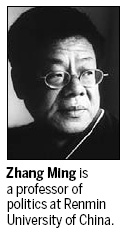
The new document has good intentions, Zhang says. But he is not so optimistic about the education system being reformed by applying traditional methods. And though China has been exploring different paths for years, it is yet to find the right way.
Because of the rapid economic development of the mid-1990s, education took a "great leap forward", but it turned out to be unsuccessful, he says. The reform campaign hastened the industrialization and "administrativization" of the education system, drawing severe public criticism. The transformation of the education system from Soviet-style to American-style is still far from complete. But in the process, the quality and fairness of education have suffered seriously.
The crux of poor educational reform is the lack of internal power, because people with vested interests may be unwilling to give up what they have earned from the current system. Besides, adopting the top-down administrative method for education reform is tantamount to taking the old path of "administrativization", which ultimately would be fruitless.
Zhang says the key premise of reform is openness. Only by opening up the education system can we solve its problems. But he prefers a gradual process of reform instead of implementing opening-up policies directly in schools.
The authorities should start pilot schools under an openness scheme in some developed regions and authorize some qualified social sectors to run them in a non-bureaucratic way, he says. It will not only create healthy competitiveness in the education system, but also promote reform in traditional schools. Competition will force the schools within the system to improve their performance and standard - a process that has proved very effective in the economic field.
Some people may worry that opening up of the education system could make it fully market-oriented and undermine public interest. But Zhang disagrees. He says the government should indeed play a role in the education system but that role should not be of arbitrary intervention. The problem with the education department is that it ignores several crucial issues that require its attention. For example, the ratio of college students from the countryside has been falling over the past few years because the authorities have failed to maintain the educational balance between urban and rural areas.
The education department's main responsibilities are to guarantee equity in education and supervise the operations of schools at all levels, Zhang says. The department should focus on making reasonable educational policies and monitoring the functioning of schools, and leave academic affairs to educators. In other words, it should concentrate on the operation of the entire education system, instead of giving instructions to individual schools and other educational institutions.
On the operational level, the National College Entrance Examination (NCEE) should be reformed on a priority basis, he says. The pressure of the NCEE forces schools, teachers, parents and even the students to try, even if reluctantly, and consolidate the existing rigid education system. No education reform can succeed without the NCEE undergoing a change.
Zhang suggests the government to promote all-round diversification in the NCEE. Every college should be authorized to enroll students according to its own principles and criteria. And students should be free to take entrance exams of as many colleges as possible and choose which one to attend after qualifying for them.
This method has several benefits. It would change the existing "standard answer-style" system by offering students more chances and more choices. It would make education a tool for all-round development of students. And it would help build students with special talents by giving full play to their creativity.
Public participation is crucial to education reform. But, Zhang says, the authorities should not practice "tyranny of the majority". Education is a social issue that relates to the development of the entire nation, not just of a few people. So the government should consider the opinions of educators and scholars who have conducted in-depth research and are more likely to be farsighted, rather than listening only to the public.
But Zhang concedes that some experts have lost their credibility after compromising on their ethics. That's why, in his articles, he urges intellectuals to maintain their independence. If education reform travels on the right track it will gradually change the unhealthy moral climate in schools and the wider society beyond the campuses.
It would be beautiful indeed to see the fruition of Zhang's ideas. But a lot of obstacles are still hindering education reform. Many people say it's hard to change the education system totally because other social sectors may be playing some role in maintaining status quo. For example, the inequity of college admission in different areas is closely related to China's hukou (household registration) system: Students have to take the NCEE in the place where their residence is registered, while colleges accept a different number of students in different areas. Rapid urbanization will draw more workers from rural areas to the cities in the coming years and the hukou system will make it more difficult for their children to get proper education.
But somebody has to take the initiative toward proper education reform. As an educator, Zhang says the education system, which is full of intellectuals, is best placed to break the deadlock. Intellectuals, especially teachers, have the social responsibility to make the first move. And only when China's education system can fully accept openness and diversification, can it produce brilliant brains to serve society.
(China Daily 03/25/2010 page9)