Op-Ed Contributors
With power comes responsibility
By David Kan Ting (China Daily)
Updated: 2010-08-25 09:01
 |
Large Medium Small |
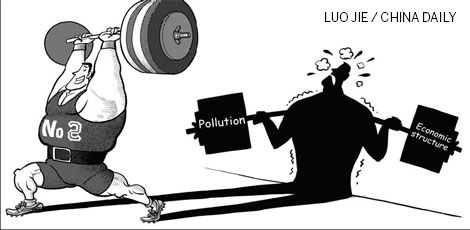
A popular saying, "with great power comes great responsibility" comes to mind when one reads of the news of China reaching another milestone in its phenomenal economic development: replacing Japan as the world's second largest economy.
Barely a decade ago, China ranked sixth in the world in terms of GDP - behind the United States, Japan, Germany, Britain, and France. In 2000, China's GDP was $1.07 trillion compared with Japan's $4.84 trillion. It seemed impossible at that time that China would surpass Japan in a decade, because it meant more than quadrupling its economic output.
Indeed, as late as March 2007, an article in the Economist surmised: "China may overtake both Germany and Japan within 15 years to become the world's second largest economy." It took just three years.
The date, however, matters less than the new milestone for the Chinese nation. It goes without saying that the news is a cause for celebration, because the pursuit of prosperity, wellness and happiness has been the goal of the Chinese people since the country's steep decline in the 19th century. Chinese people have been dreaming of resurgence since then.
In the Economist article, Angus Maddison, an economic historian at the University of Groningen in the Netherlands, has estimated that from the 1600s to the early 1800s, China accounted for between a quarter and third of the world's output.
Today, the United States accounts for a quarter of the world's GDP of $58 trillion, a status similar to China's in its heyday. Besides, the article says: "At that time China's agriculture was more advanced than the West's. It's cities (were) bigger and (people) more literate and its ruling classes more meritocratic." But can China regain its glorious past.
Nicholas D. Kristof, The New York Times' Pulitzer-Prize winning columnist and its former correspondent in Beijing, does not rule out such a possibility. In a column five years ago, Kristof wrote Kaifeng was the "world's capital" 1,000 years ago - just like New York is today. "In the 11th century, when Kaifeng was the capital of the Song Dynasty (AD 960-1279) China, its population was more than 1 million. In contrast, London's population then was about 15,000." Today, Kaifeng is unknown to most people outside China.
Kaifeng's decline is a warning for New York. The American city may end up "as Kaifeng-on-the-Hudson" if it does not learn from Kaifeng's example, that is, China turning inward because it believed it had nothing to learn from the rest of the world.
Thankfully, people think differently a millennium later, and know the real situation. "Give us a few decades and we'll catch up with the US, even pass it," Kristof quoted a young Chinese woman farmer as having said.
If the past decade is any indication, it appears that that goal could be achieved single in one decade. "China could match the US in total output as early as 2020," said a World Bank forecast in June. Even then, China will remain a developing country whose per capita income would be one-fourth of the US'. Today, China ranks below 100th in the world with a per capita GDP of $3,800, compared with Japan's $38,000 and the US' $42,000.
China, on the cusp of a historic leap into a new era of development, should learn from Kaifeng's rise and fall too.
The first lesson is to open up further - the bold idea championed by Deng Xiaoping to propel the country to the top. Innovation and education are the other forces that drive growth and sustain prosperity, as evidenced during the Southern Dynasty's (420-589) Song (AD 420-479) period inventions of printing technique, using typeface characters, which is still popular today.
Challenges abound. As the locomotive driving the world economy, which is facing its worst economic crisis since the Great Depression, China must balance its rapid growth at a projected 10 percent this year with focus on global warming. At the UN climate conference in Copenhagen in December, Premier Wen Jiabao declared that by 2020, China would cut its carbon emission intensity by 45 percent from the 2005 level. That's a tall order, as well as an example of how China is willing to shoulder its responsibility as a world power.
China will have to take better care of its environment and ecosystems, which have borne the brunt of the explosive growth. The time has come for the country to think hard about how to achieve sustainable development by striking a balance between the pursuit of GDP growth and a general renaissance to ensure that the return to past glory isn't as ephemeral as smoke and clouds.
The author is a journalist based in North America.