Op-Ed Contributors
Changing rules of the nuclear game
By Han Hua (China Daily)
Updated: 2010-09-02 08:42
 |
Large Medium Small |
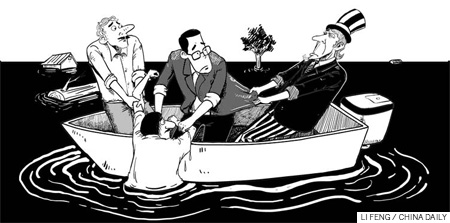
The US has been pointing a finger at China, directly or indirectly, over the past several months, especially over issues involving China's relations with its neighbors. The devastating floods in Pakistan have given it another opportunity to prod China.
Despite suffering severely from floods and landslides at home, China was one of the first countries to respond to the devastation in Pakistan. Yet Washington, on a few occasions, has expressed dissatisfaction with Beijing's contribution.
China shares a time-tested friendship with Paksitan and knows full well that it has to offer all possible help to its neighbor which is suffering from the worst floods in more than eight decades. But Pakistan needs more international aid, too, to provide food, water, shelter and medical help to millions of its people.
"China (has) acted promptly to provide humanitarian assistance to Pakistan, reflecting the profound friendship between the Chinese and Pakistani governments and peoples," Li Baodong, China's permanent representative to the UN, told the world body's General Assembly recently. China has given 120 million yuan ($17.6 million), and its companies and individuals 10 million yuan ($1.4 millions) in aid to Pakistan, and has pledged to provide more, if needed.
Sino-Pakistani friendship do not have to be measured in terms of aid. For many Chinese, the disaster in Pakistan reminds them of the devastating earthquake in Sichuan province in May 2008. When the quake survivors were in desperate need of more tents, it was the Pakistanis who collected them from wherever they could, including their strategic reserves, and sent them to Sichuan.
Some Americans are pointing a finger at China over another issue, that is, the proposed sale of Chinese nuclear reactors to Pakistan since February, when China National Nuclear Corporation announced that Beijing and Islamabad had signed a loan agreement to build two more 340-MW nuclear reactors at Chashma in Pakistan's Punjab province.
But China and Pakistan assert the proposed sale of nuclear reactors is part of their long-term nuclear cooperation agreements reached in the late 1980s. Chinese companies joined the construction team to build a nuclear plant at Chashma in 1991. By 2000, the first reactor at Chashma was ready to generate electricity, which Pakistanis need desperately. Five years later, Chinese companies began building Chashma 2, which is scheduled to be operational next year.
China and Pakistan both maintain the proposed sale is not only in line with the Nuclear Suppliers' Group (NSG) rules, but also transparent and peaceful in nature. Foreign Ministry spokesman Qin Gang told a press conference in July that the "China-Pakistan cooperation on civilian nuclear energy is consistent with the two countries' respective international obligations, (and is) for peaceful purposes and subject to IAEA (International Atomic Energy Agency) safeguard and supervision".
Although the Barack Obama administration has been generally cautious over the Sino-Pakistani deal, US Secretary of State Hillary Clinton did convey Washington's concerns to Islamabad in July and demanded a "clarification" on the deal from Beijing.
India, seen as a long-time foe of Pakistan, seems to be using diplomacy to block the Sino-Pakistani deal, even though it signed a similar deal with the US in 2006. Most China-baiters, particularly in the US, allege Chashma 3 and 4 violate NSG guidelines, which prohibit nuclear states from exporting nuclear technology and materials to non-nuclear states which, like Pakistan, are not signatories to the Nuclear Non-proliferation Treaty (NPT) and have not adopted IAEA safeguards for nuclear establishments.
Ever since China joined the NSG in 2004, some critics have been saying it has to fulfill its non-proliferation commitment and comply with the group's rules and guidelines. And because Chashma 3 and 4 were initiated after 2004, they have to be approved by NSG, most probably by seeking an "exemption" solution from its 46 member states as the US-Indian nuclear deal did in 2008.
Non-proliferation proponents have expressed concern over the Sino-Pakistani nuclear deal. But some doubt whether it could be blocked like the 2006 US-Indian nuclear deal was for setting "a dangerous precedent", because if Washington opposes it openly, it would face charges of exercising "hypocrisy" in non-proliferation.
Ashley Tellis, a senior associate at Carnegie Endowment, who as part of the George W. Bush administration played a key role in negotiating the nuclear deal with India, draws a line between the US-Indian and Sino-Pakistani nuclear deals, saying the latter is not the outcome of a public debate in Washington or in NSG. But the fact is the "integrity" of the shattered global non-proliferation regime was already breached when India, which is outside NPT, NSG and other non-proliferation regimes, was "exempted" and the US-Indian nuclear deal allowed to go ahead.
Pakistan faces severe electricity shortage leading to economic difficulties. The BBC, citing Pakistani government sources, has said Pakistan faces an energy shortfall of 3,668 MW per day. Expanding the nuclear energy industry is one way Pakistan can meet its electricity shortfall, which in turn causes social unrest and extremism. At present, nuclear power comprises just 2.34 percent of Pakistan's total energy generation.
According to a Pakistani Foreign Ministry official, the country's target is to have 8,800 MW of nuclear energy by 2030. Although people are getting increasingly worried over the security and safety of nuclear facilities in Pakistan because of the worsening political situation and threat of terrorism, Islamabad says all nuclear weapons and energy establishments have the tightest security cordon around them.
After assuming power in January last year, Obama has put two issues on top of his policy agenda: withdrawal of US troops from Iraq (and later Afghanistan) and coping with emerging powers, especially China. But it is hard to understand why the US has been trying to sow seeds of discord between China and its neighbors. As a target of US prodding, China, therefore, has to strengthen ties with all its neighbors through public and normative diplomacy.
The author is an associate professor at Peking University's School of International Studies.