Op-Ed Contributors
Inclusive growth for harmony
By Juzhong Zhuang and Jeffrey Liang (China Daily)
Updated: 2010-10-20 07:56
 |
Large Medium Small |
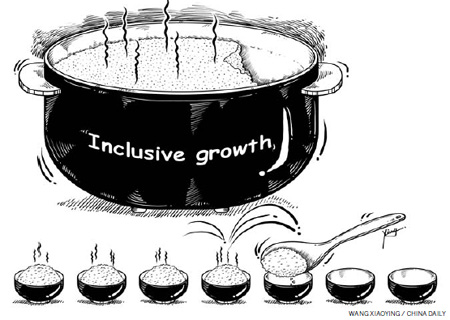
President Hu Jintao's remarks on "inclusive growth" made at the recent Asia Pacific Ecnomic Cooperation ministerial meeting underscore how China will reorient its growth model to make economic benefits more widely shared. The remarks are all the more significant, coming as they did in the midst of government deliberations on the country's 12th Five-Year Plan (2011-2015), which sets the near-term course for development.
Rising income inequality has cast a long shadow over China's otherwise spectacular economic rise of the last 30 years. Even as per capita gross domestic product grew by about 9 percent a year during 1979-2008, lifting a large section of the population out of poverty, its income inequality has risen to among the highest in Asia.
The government has in recent years taken action to address this issue through such measures as infrastructure investment in the lagging western and interior provinces, policies to facilitate rural development and benefit the farmers and rural migrant workers, and more spending on basic education and healthcare to protect vulnerable groups. More recently, it unveiled its vision of a harmonious society.
Many argue that the next five years represent a critical period for China to make significantly greater progress in reducing income inequality and toward this vision. Inclusive growth, as a practical strategy, has a pivotal role to play.
In the most general sense, one could consider growth to be inclusive when every member of society participates in and benefits from it on an equitable basis.
Critically, policies for inclusive growth should distinguish between two types of inequality. One is driven by unequal access to opportunity and circumstances beyond the control of individual - reflecting largely market and policy failures, institutional weaknesses, or social exclusion. The other is driven by differences in effort and reflects the rewards and incentives that a market economy provides for citizens who work harder, look for opportunities, and take risks in seizing them.
Naturally, it is the unequal access to opportunity that must form a nonnegotiable target of policy interventions toward inclusive growth. Accordingly, inclusive growth can be defined as "economic growth coupled with equality of opportunity".
How to translate this into policy actions?
First, inclusive growth requires high, sustained and efficient economic growth so that enough productive jobs will be created and economic opportunity expanded for all. If growth fails to provide decent jobs for a wide population, it cannot be considered inclusive.
Second, it requires social inclusion to ensure that every man and woman has equal access to opportunity. This means investing in education and healthcare to expand human capacity - especially of the disadvantaged - and eliminating market and institutional failures and social exclusion to level the playing field.
Third, inclusive growth also requires effective social safety nets to mitigate the risks and vulnerabilities associated with transitory livelihood shocks, often caused by ill health, economic crises, industrial structuring, or natural disasters, and to cater to the special needs of the disadvantaged and chronically poor.
What do these imply for China's development policy in the coming years?
Policies for inclusive growth in China must build on what has already worked. This means continue its market-oriented reform and the country's integration with the rest of the world.
Inclusive growth also means reorienting China's growth model to make it more broad-based. This requires eliminating market distortions to address imbalances and institutional and policy barriers to promote greater integration of the domestic economy. More broad-based growth will not only provide new sources of growth, but also effectively reduce income disparities between urban and rural populations and across regions.
Carefully designed redistributive policy should also be part of an inclusive growth strategy for China, the purpose being not simply to equalize incomes, but to promote equal access to opportunity so as to improve income distribution. This requires increasing investment in basic education, basic healthcare and other basic social services, and putting in place effective social protection systems.
A further important element of an inclusive growth strategy is to continue efforts to strengthen governance, promote economic and social justice and level playing fields, make government and policies more transparent, and prevent corruption. Good polices and governance are preconditions for the equalization of opportunities, which is at the core of the inclusive growth concept. It is very encouraging that many of the policies for inclusive growth are highlighted in the document of the Fifth Plenary Session of the 17th Central Committee of the Communist Party of China, which concluded on Oct 18.
The Asian Development Bank (ADB) has long been promoting inclusive growth in the Asia and Pacific region as one of its long-term strategic agenda.
Inclusive growth is also a strategic pillar of ADB's partnership with China. ADB has been supporting the development of lagging interior provinces and rural areas by investing in infrastructure, promoting natural resources conservation, and developing rural finance and agricultural extension services. ADB has also been providing technical assistance to support employment services, vocational education and training, and health and rural pension reform. As a long term development partner, ADB will continue to support China's endeavor to move toward a more inclusive and environmentally sustainable development paradigm, and strengthen its role as a regional platform to transfer and share development knowledge and experiences between China and ADB's other developing member countries.
Juzhong Zhuang is deputy chief economist of ADB, and Jeffrey Liang is head of ADB's country team for China.
(China Daily 10/20/2010 page9)