Op-Ed Contributors
Why made-in-China goods cost more
By Han Qi (China Daily)
Updated: 2010-12-14 08:09
 |
Large Medium Small |
It has become a trend among Chinese traveling abroad to go shopping for products such as iPads, laptops and cameras. The Christmas and New Year season will see more people from the Chinese mainland looking for bargains in Hong Kong and Macao, and other places.
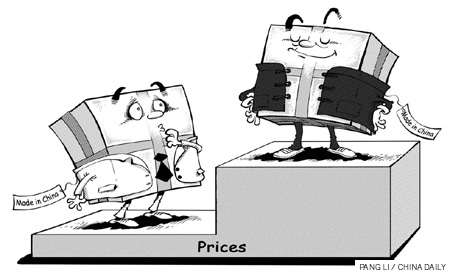
Ironically, most of the these products are made on the mainland. So why this craze? Because - ironically again - they cost more on the mainland.
Take 16 gigabyte iPads, assembled in Shenzhen, Guangdong province, for instance. Their launch price was $499 (3,326 yuan) each in the United States and HK$3,888 (3,336 yuan) in Hong Kong. But when they were launched on the mainland a year later, each cost 3,988 yuan, at least 650 yuan more than abroad.
The price difference would be even greater if we consider the per capita income in China and the US - China's per capita income is one-thirteenth of the US'.
Theoretically speaking, products made on the mainland should cost less in the domestic market. So, why do they cost more?
Export rebates on Chinese products are the main reason why goods exported from the mainland are cheaper abroad.
China already has a comparative advantage in processing and assembling products, but on top of that it grants tax rebates on those that are exported to promote economic growth and solve the unemployment problem.
It is this policy that has become the source of extra profit for many foreign companies. Given the intense competition in the global market, this policy is also lowering the profit of Chinese exporters.
Export rebates on Chinese products not only provide subsidies to developed countries by default and help people in the developed world to maintain their high consumption level, but also lower the prices of Chinese products sold abroad and make them dearer in the domestic market. A rebate of 17 percent in value added tax (VAT) means a product would cost at least 17 percent more in the domestic market than abroad.
Competition in the developed countries' markets is fierce. Many European, US and Japanese brands have more or less a fixed customer base. Therefore, they cannot win new customers in developed countries' existing market environment by pricing their products higher. Besides, logistics in developed countries are relatively well established, making it more convenient for international brands to be sold at low intermediate costs.
But when the same made-in-China products are re-exported to China, Customs duty, VAT and consumption tax are imposed on them.
The cost of products' distribution is very high in China because the country's sales network is not fully developed. Distributors have to pay relatively higher freight charges and rent for their outlets. They also have to pay a certain amount to agents at different levels of the sales chain. All these add to the prices of made-in-China products that are re-exported to and sold in the country.
Logistical costs of Chinese domestic products account for 20 to 40 percent of their prices. Even in the US, where the cost of labor is comparatively high, this percentage is much less. In fact, in the past decade it had declined to about 10 percent, and was only 8.7 percent in 2002.
Gray costs are higher in China than in developed countries because of institutional reasons. For example, railway, roadway and airway freight is yet to be completely marketized in China. As a result logistical costs are high and services are comparatively poor. Statistics show that logistical costs account for about 21.3 percent of China's GDP when they are only 10 percent in the developed world.
Besides, most of the international brands have powerful distribution networks, which give them the advantage of fixing the prices of their products, while Chinese brands are yet to do that. Because of the lack of really world-class Chinese brands, famous international brands still lead the high-end market in China. The international brands use this advantage to sell their products at much higher prices than in developed countries to earn maximum profits.
But the fact remains that the production cost of made-in-China goods is the same irrespective of whether they are sold at home or abroad. Branded products cost more in China mainly because of logistical reasons. If China can intensify its reform and cut these costs, international brands made in China would cost much less in the domestic market and fewer Chinese would buy them abroad or smuggle them from across the borders. More importantly, it will boost domestic consumption.
The author is a professor of economics at the University of International Business and Economics,Beijing.