Op-Ed Contributors
Debate: Chinese mothers
(China Daily)
Updated: 2011-02-09 08:11
 |
Large Medium Small |
Li Jianzhong
Nothing wrong with education system
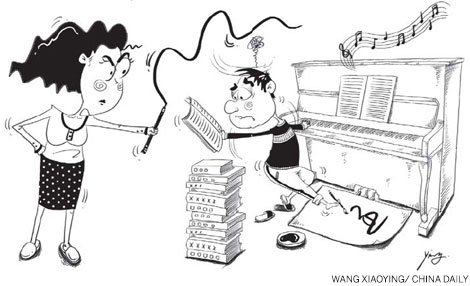
Amy Chua's Battle Hymn of the Tiger Mother - especially its excerpt, Why Chinese Mothers are Superior - has sparked a debate over Chinese-style parenting and raised concern for two reasons:
First, the Chinese American author, mother of two daughters and a professor of law in Yale, has laid out the "ten commandments" for her daughters. For instance, the Chua sisters have to get A grades in all subjects and are not allowed to spend the night at any friend's place. Their mothers kept them focused on their studies, and didn't allow them to be distracted by extracurricular activities.
Second, this rigorous regime helps the Chua sisters shine in their studies. The elder sister is known for her piano recital at the Carnegie Hall, and the younger boasts an excellent academic record. And Amy Chua attributes her daughters' achievement to her Chinese-style parenting strategy.
Readers have responded to the book in two ways. A survey of Chinese netizens' shows 60.7 percent of respondents agree with her views. But people in the West are less enthusiastic about the Chinese parenting style and warn that it could kill children's creativity and innovativeness.
Lawrence Solomon has cited statistics in his recent column in Canada's Globe and Mail to show the failure of Chinese parenting. He writes that only 10 ethnic Chinese scientists outside the Chinese mainland have won the Nobel Prize in the past century. In contrast, American scientists have won more than 300 Nobel prizes, and Jews, who account for only 1 percent of the world's population, have got at least 180 - or almost one-fourth - of the prizes.
Many Westerners call people like Amy Chua, who they think disregard children's preferences, "tiger mothers". On the other hand, many Chinese parents believe that they care more about and are willing to make greater sacrifices for their children than their Western counterparts. Such disagreement is understandable, given the differences between Eastern and Western cultures and traditions.
The truth is that no culture or tradition, whether Eastern or Western, is superior or inferior. The same applies to Eastern and Western education systems. Both sides should stop using their concepts and values to judge the other. Rather, they should learn the good aspects of each other's systems and clear the misunderstandings.
For a long time, some people have been saying that China's education system hampers students' innovative capability and does not prepare them for the practical problems of the real world. But this view is not true. And the Nobel Prize should not be taken as the yardstick of a country's innovative capability, because it is not only about education and factors such as management and finance complicate the award's mechanism.
In fact, China's achievement in basic education is exemplary. Data from the Organization for Economic Cooperation and Development (OECD) Program for International Student Assessment (PISA) in December showed the 15-year-old students from Shanghai secured the top ranks in reading, mathematics and science in the world. The performance of students from the US, where the per capita GDP is three times that of Shanghai, was much below their Shanghai counterparts and just equal to the average in OECD countries.
Though the standard of education in Shanghai is higher than in most parts of China, the country has made great progress in education reform and Chinese mothers have played an important role in the process by setting high standards for their children.
It is common knowledge that overseas Chinese who follow traditional Chinese education concepts excel in academic fields. US statistics show that Chinese Americans account for only 5 percent of the US population but 20 percent of the students in Ivy League schools. Besides, one-third of the US Intel Science Talent Search awardees in 2010 were Chinese American competitors.
Likewise, Chinese Canadians account for more than one-third of the students in Canada's two most famous universities, Toronto University and the University of British Columbia.
Influenced by Confucius' teachings, students from the Republic of Korea and Japan are also excelling in academic fields. Their success owes in no small measure to their parents, especially their mothers, who make their children study more seriously and spend more money on their education.
Indeed, research in education in China shows that to secure good scores and ranking, students have to spend more time and energy on studies, which probably is a test of their self-discipline. In this sense, a mother's supervision is of vital importance.
Soon after the PISA report was published, Japan's Ministry of Education, Culture, Sports, Science and Technology sent officials to China to study it with China's National Institute for Education Research. Tokyo's move shows that Japanese educators are also worried about their students' performance. Over the past decade, Tokyo has loosened its education policies, because of which Japanese students have been slipping steadily in international rankings.
Viewed in this light, Chinese parents have played a very important role in reforming the country's education system, and will continue to do so.
The author is a research scholar with the China National Institute for Education Research, affiliated to the Ministry of Education.
(China Daily 02/09/2011 page9)
| 分享按鈕 |