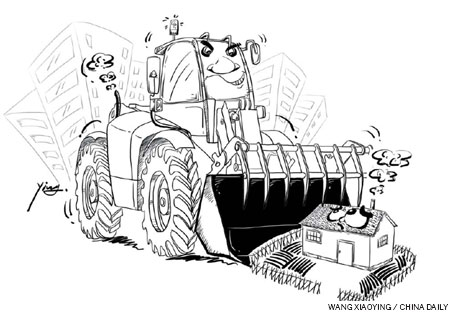
One of the hottest topics in China today is food prices, especially prices of agricultural products and how to increase farmers' income. The government's monetary policies are well suited to curb rising vegetable and fruit prices, though natural calamities and external shocks sometimes reduce agricultural yields, which in turn increase prices. But fortunately their effects are short-lived and prices fall after a couple of months.
The problem of how to increase farmers' income is somewhat more complex and its solution not so easy.
At the risk of over-simplification, it appears that the solution to the current problem is urbanization, that is, encouraging farmers and, more generally, rural residents to move to cities where they can get jobs, save as much as possible and remit a large portion of their income to their families in rural areas.
|
||||
This system works relatively well, given that people's income in cities, even at the lowest end of the scale, is more than what people can earn by toiling in the fields. The plan for the foreseeable future envisages that every year about 1 percent of the population will move from the countryside to cities. This system makes everyone happy: more income for migrant workers, more business for property developers, and higher GDPs for local governments.
But if we look at how rural households' income has evolved over time, the picture that emerges is less rosy. National Bureau of Statistics figures show that rural net income from household operations (including all rural activities like farming, animal husbandry, fishery and forestry) has grown by an average of only 7-8 percent a year over the last 10 years, well below nominal GDP growth.
The figures indicate that, although economic conditions have improved in real terms (rural CPI being only about 3 percent a year on average), rural residents have not benefited proportionately from the overall wealth created within the country. This situation is, however, mitigated by the larger increase in income derived from non-rural activities, such as wages and salaries, so that total income of rural residents has grown by about 10 percent a year. In simple terms, farmers take up employment elsewhere to boost their income.
One of the causes of this phenomenon is, once again, urbanization: Encouraging farmers to move to cities does greatly help them increase their income, but it also squeezes out those who are left behind.
 New type of urbanization is in the details

Copyright 1995 - . All rights reserved. The content (including but not limited to text, photo, multimedia information, etc) published in this site belongs to China Daily Information Co (CDIC). Without written authorization from CDIC, such content shall not be republished or used in any form. Note: Browsers with 1024*768 or higher resolution are suggested for this site.
License for publishing multimedia online 0108263 Registration Number: 130349