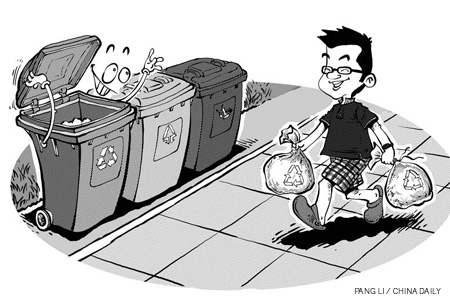
Municipal waste management is no easy task, but there is a win-win solution for Chinese cities that fits well with the country's ambitions for circular economy and sustainable development - separating trash from treasure.
Household waste is a serious problem in China today. The amount of municipal waste collected and transported each year jumped from 30 million tons in 1980 to more than 160 million tons in 2009. And it has become increasingly difficult to build landfills and incineration facilities, still the main mode of waste treatment in China, because of scarcity of land and public concern over their impacts on people's health and the environment.
Clearly, there is an urgent need to transform this traditional model, which relies on landfills and incinerators, into a modern one, which emphasizes "reduce, reuse and recycle".
The 12th Five-Year Plan (2011-2015) emphasizes "establishing a sound collection and recycling system for separated waste, improving the systems for separated waste collection, enclosed transportation and centralized waste treatment, and promoting resource utilization and hazard-free treatment of foods and other waste".
In recent years, a number of Chinese cities have begun carrying out household waste separation pilot projects. But none has truly succeeded because of inadequate waste collection and transportation infrastructure, and low public awareness and participation. Ningbo city in Zhejiang province is currently working with the World Bank to prepare an investment project coupled with technical assistance to put in place a modern waste management system featuring separation, recycle and reuse of household waste as a resource.
Many developed countries have successful experiences in waste separation and recycling that China can learn from. The focus is on treating waste as a "resource" not garbage. Almost all wastes can be used after they are separated, decontaminated and processed appropriately.
 New type of urbanization is in the details

Copyright 1995 - . All rights reserved. The content (including but not limited to text, photo, multimedia information, etc) published in this site belongs to China Daily Information Co (CDIC). Without written authorization from CDIC, such content shall not be republished or used in any form. Note: Browsers with 1024*768 or higher resolution are suggested for this site.
License for publishing multimedia online 0108263 Registration Number: 130349