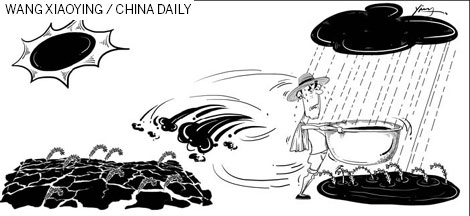
As global food prices continue to soar (wheat and corn prices have nearly doubled since June 2010), a severe drought in South and Central China is reviving fears over domestic food inflation and its potential effects on global grain markets.
Drought in China is not new. Back in February, the country experienced a serious drought in some major wheat producing regions, mainly in the northern areas, and international experts predicted that China's wheat production would decline by a significant margin. But latest Ministry of Agriculture estimates show that wheat output will actually increase by 2 percent because of the measures taken by the central and local governments, as well as farmers.
The drought in South and Central China, however, is severe and precipitation in the rice producing regions along the Yangtze River basin is at its lowest in 50 years. This once again raises the question: Will the grain production decline and will China need to import large amounts of grains.
While the rain during the past few days would replenish water supplies in the region, it may not be enough to make up for the 40-60 percent shortfall. In fact, the shortfall has already caused some damage to crop production. In some areas, floods may become a new challenge.
According to the National Bureau of Statistics, food inflation has increased by 11.5 percent since last year, and retail rice prices rose by 29 percent between December 2009 and May 2011. But it is important to keep in mind that other factors, such as the weak US dollar, the impact of oil prices on biofuels demand, excess liquidity and strong economic growth are also contributing to food inflation.
Although rice output will fall, the drought should not have a serious impact on domestic or global grain markets. The bulk of grain production to suffer is the early rice harvest, which accounts for only 25 percent of the total summer crop output. Many experts say the drought will cause a loss of only 1 percent of the total annual grain production. In addition, China has sufficient grain stocks (about 200 million tons) to ensure food security, and the government's drought-relief efforts will help avoid a crisis.
Although China's grain imports have increased over the last two years, its imports and exports are small in comparison to large emerging economies such as Brazil and developed countries like the United States. Indeed, the dry weather affecting the world's top two grain exporters (Europe and the US) is more likely to have an impact on global grain prices in the short term than the drought in China.
But if another drought or flood hits China during the summer months, it would affect the major harvest in fall and production could drop considerably. The government has to closely monitor the situation to evaluate the actual impact on production after the fall harvest.
In the long run, climate change - causing frequent and intense extreme weather events - population growth, changing diets and increasing urbanization will continue to place severe strain on China's natural resources and food production.
By 2050, global prices of wheat and rice are projected to increase by 75 percent and 25 percent. By that time, China's population is likely to reach 1.5 billion and its more urbanized and affluent society is likely to demand better and more diverse food, such as fruits, vegetables and meat.
Ensuring self-sufficiency in food will, therefore, be a major challenge for China, but it could also be an opportunity for its agricultural sector. If China implements the right mix of investments and policies to develop new technologies and increase productivity, and protects its water, land and forests, it could succeed in not only ensuring food security, but also in contributing to a more food-secure world.
To achieve its food security goals in the short and long term, the Chinese government should take the following measures.
First, it should release national grain stocks, specifically targeting poor people in areas most affected by drought to help protect the population that is most vulnerable to rise in food prices. The government should also establish or scale up social safety nets to protect the poor and vulnerable, particularly women, children and the elderly, through direct cash transfers.
Second, the government should make irrigation water accessible to farmers during droughts. By releasing reservoir water and helping pump underground water, the authorities will help poor, smallholding farmers to cope with a drought's impact on food and income security both. Although officials in charge of the Three Gorges Dam have released water, more support is needed, especially for poor farmers.
Third, the government should prevent hoarding and speculation through better market regulations, because the likelihood of severe food shortage and huge increase in prices, in some cases, have led to increased stockpiling, hoarding and speculation. Such activities increase food prices and heighten price volatility.
In addition, the knock-on effect such activities can have on prices will be more salient when large food production companies start hoarding than when small farmers do so. To avoid this, the government should take measures to reduce speculation in food commodities. For example, the government should continue monitoring purchases by grain reserve enterprises closely to prevent price manipulation and ensure transparent transactions.
Fourth, the authorities should ensure open trade because it is critical to enhancing the efficiency of food markets. During crises, it is important for the government to avoid import or export restrictions to prevent distortions in the domestic market and price volatility in the international market.
Fifth, the government should protect land and water resources through strong institutions and markets. It should regulate land use and establish a system to grant incentives for land conservation. Investment in irrigation and water storage can help reduce drought-related risks, and promote the use of moisture conservation and water harvesting techniques.
New anti-drought measures launched recently by the government, including investments in emergency digging of wells and irrigation equipment, are very important. Rural communities can diversify their incomes by choosing livelihoods that are less dependent on rainfall. To help farmers make well-informed decisions and investments, weather and climate change information should be made easily accessible to them.
Sixth, the government's investment in science and technology should be geared toward increasing productivity, especially among smallholding farmers, and to develop resilience to climate change and weather shocks. In particular, investments in drought-resistant crop varieties, water-saving technologies that suit specific regions and technologies that promote water conservation will be crucial. Also important will be investments in climate change adaptation and mitigation measures that exploit agriculture's full potential.
The author is director general of International Food Policy Research Institute based in Washington D.C.
 New type of urbanization is in the details

Copyright 1995 - . All rights reserved. The content (including but not limited to text, photo, multimedia information, etc) published in this site belongs to China Daily Information Co (CDIC). Without written authorization from CDIC, such content shall not be republished or used in any form. Note: Browsers with 1024*768 or higher resolution are suggested for this site.
License for publishing multimedia online 0108263 Registration Number: 130349