China's Law on Intangible Cultural Heritage (ICH), the first of its kind and implemented on June 1, has been hailed by experts as a milestone in the country's efforts to preserve its historical, literary, artistic and scientific traditions.
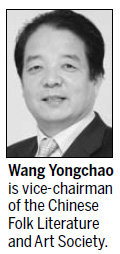
One of these experts is Wang Yongchao, vice-chairman of the Chinese Folk Literature and Art Society. He says the law has come as a great relief, because it will encourage people like him who have been trying to protect China's cultural heritage for years.
According to the law, "intangible cultural heritage" refers to various traditional cultural manifestations handed down from generation to generation by people of all ethnic groups, and objects and spaces relevant to traditional cultural manifestations. ICH includes traditional oral literature and the languages thereof; traditional fine arts, calligraphy, music, dance and drama, quyi and acrobatics; traditional techniques, medicines and calendar; traditional rituals, festivals and other folk customs; and traditional sports and forms of entertainment.
A variety of folk literature and art did not fall in the ambit of ICH before, and people did little to preserve them, Wang says. As a result, many forms of folk literature are fast disappearing in the tide of modernization and globalization.
Now that there is a law to abide by, efforts to protect ICH has entered a whole new era, because it specifies that governments at the county level and above should implement policies and set budgets to protect ICH.
There is a hitch, however, Wang says. The law requires governments at different levels to protect ICH but does not say how to promote them. Considering that in poor and remote areas, where intangible cultural heritage forms remain shielded from culture shock but local governments lack funds, the challenge is how to help preserve them.
Even after the enforcement of the law, attention needs to be paid to other aspects, Wang says. So far, efforts have been focused on the importance and protection of ICH, but there is lack of scientific research and categorization for the different types of ICH on the basis of folklore and cultural anthropology.
Besides, some local governments tend to apply ICH titles to local folk literature but are passive on its preservation. This does not help long-term protection.
The implementation of the law means that China has started a relatively well-developed system of ICH preservation and protection. To make it a success, the government should take measures during the 12th Five-Year Plan (2011-2015) to build region-centric bases in areas that have a wide variety of ICH. It should introduce a mechanism, too, to assess and confer ICH titles and help protect them, and take off the ICH list those that no longer measure up to the national standards.
Wang is 55 years old and has devoted his entire working life to protecting ICH. He has spent more than 330 million yuan ($50.95 million) of his own money on 8,600 ancient Chinese hitching posts, which make up just a part of his collection of 33,600 artifacts in his self-founded Guanzhong Folk Art Museum in Xi'an, Shaanxi province.
He says the fast pace of industrialization, urbanization and modernization has created new challenges for ICH protection. With China's social economy in transformation, many types of ICH that have passed from generation to generation mainly through oral teaching and instructions are facing the threat of being lost, and some are already on the verge of extinction.
For example, the art of wood-cutting for block printing of Buddhist sutras has been inherited by generations of wood carvers in Nanjing since the late Qing Dynasty (1644-1911). Though the art was categorized as a national-level ICH in 2006, young apprentices have become increasingly difficult to come by.
Contrary to common perception, the two artisans who have been carrying on the art for nearly 30 and 20 years earn just 2,000 to 3,000 yuan a month, merely enough to survive in a city like Nanjing.
The Ministry of Culture, however, has raised the fund support to people who have inherited national-level ICH from 8,000 yuan to 10,000 yuan a year. Such financial support will continue to be increased in the future. Some of the people who have kept alive such ICH are rich, but others earn barely enough to lead a decent life. Wang says official efforts should be focused on helping those who are struggling.
The government should intensify efforts to protect areas, particularly remote areas, which nourish folk literature and art but are highly vulnerable to outside influence in these times of urbanization. Private investment should be encouraged to join the cause, too.
In short, the law should not be regarded as a solution to all the problems, Wang warns. It should be seen as a start, which it is, rather than an end in itself. The law only serves as a basis for ICH protection; it needs the help of a series of supplementary laws, rules and policies that should now be promulgated.
And since many clauses of the ICH law are linked with provisions of other laws such as the Law on the Protection of Cultural Relics, Customs Law and the Intellectual Property Rights Law, efforts should be made to set up a coordination mechanism among all of them as soon as possible, so that ICH protection can become part of a grander system of legal protection, Wang says.
 New type of urbanization is in the details

Copyright 1995 - . All rights reserved. The content (including but not limited to text, photo, multimedia information, etc) published in this site belongs to China Daily Information Co (CDIC). Without written authorization from CDIC, such content shall not be republished or used in any form. Note: Browsers with 1024*768 or higher resolution are suggested for this site.
License for publishing multimedia online 0108263 Registration Number: 130349