| ?
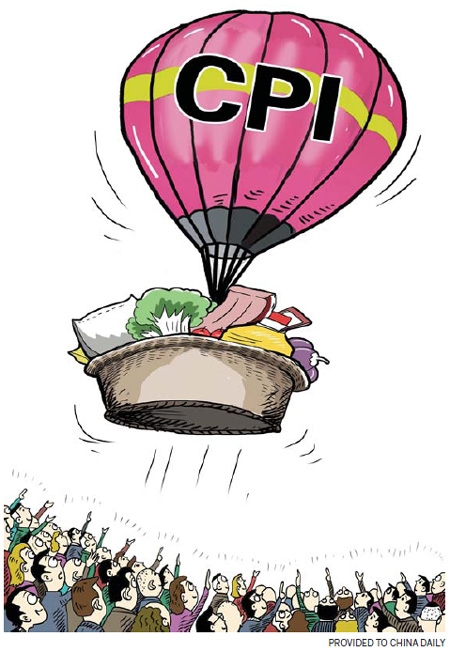 |
Inflation has emerged as one of the key social and economic challenges confronting the Chinese government this year. Some even fear that China is now exporting inflation to the rest of the world after many years of holding down global prices for manufacturing goods through low-cost labor.
These two issues were explored in detail as part of this year's International Monetary Fund's review of the Chinese economy, called 2011 Article IV Report on China. The review concludes that China has the tools to successfully combat inflation and that there is no convincing sign that its domestic price pressures are systematically spilling over to international markets.
Over the last year, China's inflation rate has more than doubled with food items accounting for nearly three-fourths of this increase. A large part of the food-linked inflation can be traced to a series of natural disasters in 2010, including droughts in the southwest and flooding in Hainan that disrupted the supply of fruits and vegetables.
The urban poor and rural households not engaged in farming have suffered most since food accounts for a large share of their overall consumption and their incomes have lagged rising prices. Over time, these shocks spilled over to core inflation, particularly housing and clothes, against the backdrop of bank lending exceeding the government's target for 2010 and rising global commodity prices. Today, inflation stands at a three-year high and nearly half the urban population expects prices to continue rising.
Meanwhile, prices of China's exports on the international market, particularly for labor-intensive products such as textiles and footwear, have also increased. A number of commentators argue that this reflects the start of a trend spurred by higher wages, with the country beginning to run out of workers as a result of demographic changes.
The evidence, however, does not necessarily support this assertion. First, export prices for other Asian economies - for example, South Korea, Malaysia and Taiwan - have also shown similar increases. This suggests that the rise is being driven more by a pass-through of rising global commodity prices, including oil and cotton, than by country-specific cost pressures. Indeed, a similar pattern was witnessed during the oil price boom of 2007-2008. Second, despite some labor market tightening, China still has a surplus of workers, with significant underemployment in some sectors. Overall, wage increases have not run too far ahead of productivity gains in recent years and corporate profit margins remain intact.
That said, China's policymakers are certainly right to be worried about inflation. International experience shows that high and sustained inflation can be damaging to macroeconomic and social stability.
First, increases in prices that outstrip income gains reduce purchasing power, particularly for the poor and most vulnerable in society. Second, inflation redistributes income in ways that may not be equitable or efficient - for instance from pensioners, savers and creditors toward borrowers whose debt falls in value. Third, it reduces the incentives to invest and employ workers by creating uncertainty about the value of future returns. And fourth, when caused by an overheating economy, inflation can lead to a boom-bust cycle that can devastate livelihoods.
At the moment, the supply shocks to food prices that drove inflation up over the last year are working their way through the economy. They should gradually ease as agricultural output recovers. However, there are risks. As the recent pork shortage demonstrates, food prices in China remain vulnerable to additional unexpected shocks, including from bad weather and disease. Externally, food prices, including cereals, oilseeds, dairy, meat and sugar, are near record highs, and global commodity prices could rise further amid continuing uncertainty about oil supply due to unrest in the Middle East.
To ensure a decline in China's inflation and prevent a dangerous wage-price spiral, it is essential that people's expectations about future prices remain under control in the coming months. Implementing the tighter monetary policy planned for this year will be key and is currently being achieved predominantly through a slower credit supply. More emphasis on increasing interest rates will reinforce this tightening by also containing the demand for credit by borrowers in the economy.
To ease the burden on the most vulnerable groups, targeted food subsidies can be considered, while reducing reliance on administrative measures. Such measures can artificially dampen prices in the short run but at a cost, they also suppress incentives for increased supply over the medium-term. This could be particularly damaging in the case of certain consumer goods and agricultural products, for which demand will continue to rise as China urbanizes and becomes richer. In addition, faster appreciation of the renminbi would help hold down the price of imports and limit their spillover impact on domestic prices, particularly if global commodity prices spike further.
If such policies are in place and there are no further disruptions to domestic food supply, inflation should fall back toward the government's target of 4 percent during the second half of the year.
The author is deputy resident representative in the IMF's China office. The opinions expressed in the article do not necessarily reflect those of China Daily.
 New type of urbanization is in the details

Copyright 1995 - . All rights reserved. The content (including but not limited to text, photo, multimedia information, etc) published in this site belongs to China Daily Information Co (CDIC). Without written authorization from CDIC, such content shall not be republished or used in any form. Note: Browsers with 1024*768 or higher resolution are suggested for this site.
License for publishing multimedia online 0108263 Registration Number: 130349