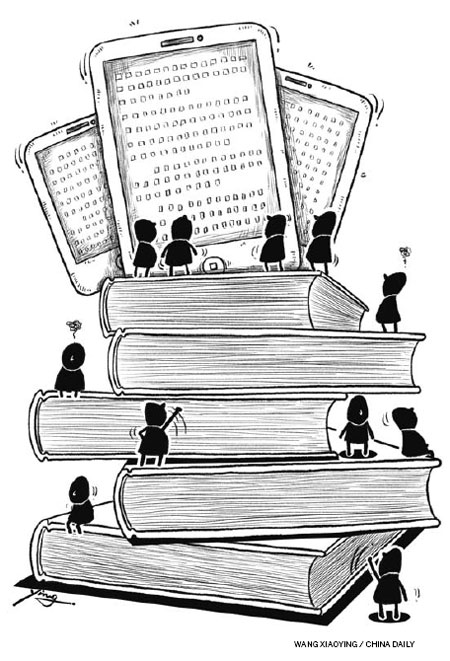
A recent national survey shows a strong growth in digital reading, with 252 million Chinese aged between 18 and 70 reading books and articles online in 2010 and about 83.6 percent of the respondents saying they would prefer the electronic version of a book if available.
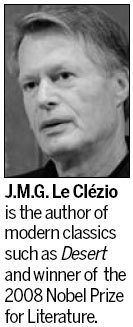 |
So will e-reading replace books one day? "There are now many ways of spreading knowledge like the computer, which may one day replace Gutenberg's invention," says J.M.G. Le Clzio, "but I cannot imagine a world without books." He hastens to add, though: "It (the book) is a tool as indispensable as hammer, knife, lamp or teapot, and as delicate as violin, flute and percussion instrument."
Le Clzio, "author of new departures, poetic adventure and sensual ecstasy, explorer of a humanity beyond and below the reigning civilization" as the Nobel Committee described him while awarding the Literature prize in 2008, was invited by Nanjing University to deliver a lecture on "Books and our World" on Aug 21. Talking to China Daily on books and new media, he says books have played an essential role in the development of the world, by granting universal access to knowledge and turning it from the privilege of dominant classes into ordinary people's rights a role it performed especially well during Enlightenment.
"Without printed books we would be living in a totally different world. It may prosper as well, but it will be a closed world resistant to progress, desperately imbalanced, filled with unfairness and injustice." He cites the ancient Mayan civilization as an example. What was once illuminating and ripe disappeared for want of print: "There was no democracy and hardly equality before the law while the quality of citizen dwelled on a relatively low level."
"In such a world, knowledge would not serve interaction or social progress, but only draw a new line between those who have knowledge and those who don't There can still be marvellous wonders like the Pyramid, but the people will only build them like slaves, not understanding the meaning of their labor."
The essential role of the media, old or new, is to offer everyone in society equal access to culture and knowledge, so that no one is illiterate and thus socially inferior, says the author of masterpieces such as Desert, Onitsha, Wandering Star: A Novel and Terra Amata. "The book, however old-fashioned it may be, is the ideal tool. It is practical, easy to handle, economical. It does not require any particular technological prowess, and keeps well in any climate."
Compared with new media that have the advantages of being timely, interactive and having larger information capacity, traditional books have a unique and eternal charm: "A book has nothing to do with video or audio; it is like slow food, the content of which must be dealt with slowly." For Le Clzio, and for others who share his passion and pleasure, a book is something to "digest", to "reflect, to read one part of it and leave some" for another day. It offers a different path from the culture of fast food, that is, reading through network-based new media, and it will always appeal to those who wish to get a thorough understanding of knowledge.
"Its (the book's) only flaw - and this is where I would like to address publishers in particular - is that in a great number of countries it is still difficult to gain access to books." In Mauritius, which he calls his "little fatherland", the price of a novel is equivalent to a sizable portion of a family's budget, while in many developing countries in Africa and other continents books remain an inaccessible luxury.
That has been a paradox for him as an author, and for which he often cites Swedish writer Stig Dagerman to describe: "While all he (the writer) wanted was to write for those who are hungry, he now discovers that it is only those who have plenty to eat who have the leisure to take notice of his existence." As a remedy, Le Clzio has proposed joint publications with developing countries, establishment of funds for lending libraries and book mobiles, and greater attention to requests from and works in so-called minority languages to make literature and books continue to be a wonderful tool for knowledge.
His wife, sitting beside him, adds that he has devoted much effort to that work. "He sends books to libraries that need books, and goes to publishers and lets them send books too." His new book, a collection of short stories, will hit the stands in France in October.
Like some other writers, Le Clzio has maintained the habit of writing with pencil and paper, his wife says. In fact, it was in Nice just after the end of World War II, when material shortage was most serious, that he wrote his first text, on the back of a ration book, using a carpenter's blue and red pencil. "Pencil is the normal tool (of writing) for him."
But keen love for paper books does not prevent Le Clzio from employing modern technology as well. He thinks new media like the Internet, if well used, can help books play their role better by promoting understanding and interaction. "I love very much the Internet, and I think it is a great invention People will get better understanding, better news circulation, every kind of communication."
He thinks new media can serve to further break the monopoly of power on knowledge and information by granting universal access, by making everyone understand what is happening. "It probably can bring peace. Who knows, if the Internet had existed at the time, perhaps Hitler's criminal plot would not have succeeded - ridicule might have prevented it from ever seeing the light of day."
But to perform that role, the Internet must be used to spread the knowledge of books and written language, or we would enter the process of "drawing a new line to divide those who have access to communications and knowledge, and those who are left out". He hopes that every "child receives the benefits of writing" through the progress in communications so as to "provide a foundation for equality".
The only flaw of the Internet is that its information can be untrue, he says. But "books can be wrong too". The need is to make access to knowledge and culture universal because the more people know the less possible will it be for them to believe in wrong information. "Neither books nor new media can foretell the future but I believe in progress."
(China Daily 08/31/2011 page9)
 New type of urbanization is in the details

Copyright 1995 - . All rights reserved. The content (including but not limited to text, photo, multimedia information, etc) published in this site belongs to China Daily Information Co (CDIC). Without written authorization from CDIC, such content shall not be republished or used in any form. Note: Browsers with 1024*768 or higher resolution are suggested for this site.
License for publishing multimedia online 0108263 Registration Number: 130349