China and other emerging economic powers can play a leading role
Born in a small village by the Yangtze River, I witnessed how the Maoist health system, with its commitment to equity and universal access, successfully brought down the incidence of infectious diseases and significantly improved public health.
I saw how in the 1970s most people just hoped for a bowl of rice, but relatively few died of stroke, diabetes, cancer or heart disease.
Much like tuberculosis - which was seen by some in the 19th century as an expression of beauty and creativity from those infected - chronic, noncommunicable diseases were long considered ailments of affluence in rich countries.
Not anymore.
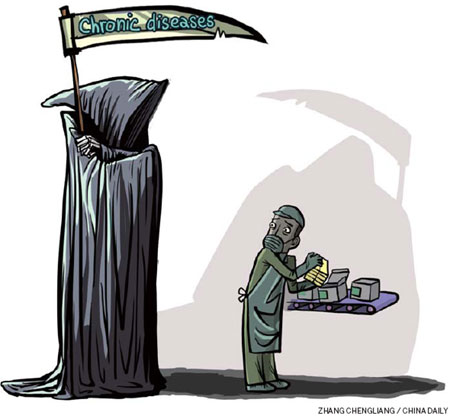
With globalization, urbanization and economic growth, noncommunicable diseases are the major cause of death and disability, even in the developing world. Since the 1980s, lower- and middle-income countries have seen the rapid rise of fat intake, which is associated with heart disease. These populations are aging faster, increasing the likelihood of people developing chronic diseases later in life.
According to the World Health Organization, nearly 80 percent of chronic diseases today occur in low- and middle-income countries. The burden of noncommunicable diseases is particularly high for emerging economic powers like Brazil, Russia, India and China, which together with South Africa are known as BRICS.
Around 85 percent of deaths in China, 81 percent in Russia, 75 percent in Brazil and 53 percent in India are caused by chronic diseases. Even in South Africa, where HIV/AIDS is the leading killer among adults, the burden of chronic disease is growing.
BRICS as a group is leading a global explosion of diseases such as diabetes. According to recent research in the medical journal The Lancet, 138 million of those with diabetes - or 40 percent of the world's diabetes population - live in China and India. And China overtook India to be the diabetes capital last year. As one epidemiologist put it, for every person worldwide with HIV/AIDS, there are three people in China with diabetes.
The epidemic of noncommunicable diseases bodes ill for development. Research shows that a 10 percent increase in chronic disease is associated with a 0.5 percent decrease in annual economic growth. A report from the World Health Organization found that Brazil, China, India and Russia together currently lose more than 20 million productive life years annually to chronic disease.
 New type of urbanization is in the details

Copyright 1995 - . All rights reserved. The content (including but not limited to text, photo, multimedia information, etc) published in this site belongs to China Daily Information Co (CDIC). Without written authorization from CDIC, such content shall not be republished or used in any form. Note: Browsers with 1024*768 or higher resolution are suggested for this site.
License for publishing multimedia online 0108263 Registration Number: 130349