|
Luo Jie / China Daily |
Hawaii will host the 2011 Asia-Pacific Economic Cooperation (APEC) forum from Thursday to Saturday, the second time the United States will be holding the event in 18 years.
The first APEC Economic Leaders' Meeting was held in 1993 at the initiation of former US president Bill Clinton, who had just assumed office. Clinton was aware of the increasing importance of the region and determined to expedite the establishment of "a new Pacific community". But later, he reconciled his proposal with shared commitment to deepen the spirit of community.
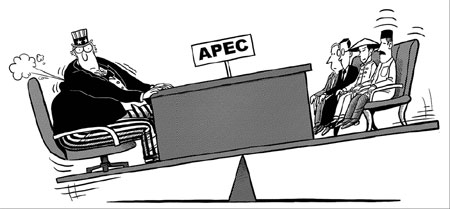
Eighteen years have passed since then, and one wonders what the US would call for now and how its status and influence in the APEC have changed.
Established in 1989, APEC has been a regional forum of dialogue. Any decision made in the forum is based on consensus and non-binding principles, and transformed into concrete actions on a voluntary basis, which means APEC runs without an institutionalized negotiation mechanism.
In the past two decades, APEC has adopted many strategic approaches and operated with a high degree of flexibility and diversity. Leaders of APEC member economies said in the 1996 Leaders' Declaration that "the strength of APEC is derived from its diversity and that we are bound by a shared vision of community" and "deepening the spirit of community in accordance with the APEC approach is critical in exerting a positive influence on the region and on the world".
Back in 1993, when it hosted the first APEC Economic Leaders' Meeting, the US was rejoicing in the collapse of the Soviet Union and becoming incontrovertibly the world's dominant power. Washington was ambitious and made that clear in a national security strategy, which said the US would continue to lead the world and that it would exercise its leadership around the globe in the new century, ultimately, "for the preservation of peace". What it meant to say was, the proposed "new Pacific community" would be built on the West's shared universal values, US-dominated security cooperation and US-led trade and investment liberalization.
Despite the passage of time and the changes that have taken place in the balance of power, the US' ambition of leading the world remains unchanged. This was especially evident when US President Barack Obama called himself "America's first Pacific president" and declared that" "I do not accept second place for the United States of America".
But whether it likes it or not, the US has to make adjustments, just as the late US diplomat George Kennan said: "This planet is never going to be ruled from any single political center, whatever its military power", and "what we ought to do at this point is to try to cut ourselves down to size in the dreams and aspirations we direct to our possibilities for world leadership."
Today, most of the APEC member economies agree to deepen the spirit of community and work toward the goal of establishing a harmonious community in the region in pursuit of peace and development. For that purpose, China advocates mutually beneficial cooperation and the building of a harmonious neighborhood and world. But despite the region being war-free now, it is not that peaceful because of the continuing impact of the Cold War mentality, troubles created by arms dealers and behind-the-curtain alliance politics.
Therefore, at the upcoming Hawaii meeting, leaders of APEC member economies should touch upon security issues based on mutual trust and abandon their Cold War mentality. Just as a Chinese saying goes "harmony in the family is the basis of success in any undertaking", only a harmonious APEC can help the member economies clear their intricate differences, better respond to non-traditional security challenges and spread peace, development and common prosperity.
The US has three goals to fulfill at the Hawaii meeting to gain more market access and realize its self-proclaimed institutional advantage. First, it has to strengthen regional economic integration and expand trade. Second, it should promote green growth. And third, it has to intensify its regulatory cooperation and convergence.
The US' calculation is understandable. But it would be unacceptable if it involves double standard and politicization of normal trade ties, because all member economies have their own advantages and should develop equal partnerships within the APEC framework on a voluntary basis.
Besides, before taking another stride, the US should first answer whether or not it has lived up to the Bogor Goals that aim to establish free and open trade and investment in the Asia-Pacific region by 2010 for industrial economies. The US should also answer why it is promoting the Trans-Pacific Partnership instead of spurring the building of the APEC free trade zone.
Since the shoe is on the other foot now, the US behaves quite differently today from the way it did 18 years ago, when it held the overriding influence in the region. Let's hope that the US can keep pace with the times and accommodate itself to the trend of peace, development and mutually beneficial cooperation.
The author is executive director of the Strategy Research Center of China International Studies Research Fund, and a former senior APEC official.
(China Daily 11/10/2011 page9)
 New type of urbanization is in the details

Copyright 1995 - . All rights reserved. The content (including but not limited to text, photo, multimedia information, etc) published in this site belongs to China Daily Information Co (CDIC). Without written authorization from CDIC, such content shall not be republished or used in any form. Note: Browsers with 1024*768 or higher resolution are suggested for this site.
License for publishing multimedia online 0108263 Registration Number: 130349