Cao Xiaoyang and Zhang Jie
A great challenge awaits Asia-Pacific neighbors
Compared with 2010, China's security environment hasn't improved much this year. As things stand today, China faces five main problems: the stalemate on the Korean Peninsula, strengthening of the United States-Japan alliance, intensification of maritime territorial disputes, escalating an arms race and rising non-traditional challenges, with non-traditional challenges to China's maritime security being especially serious.
It seems difficult to resume the Six-Party Talks, an essential channel of keeping the situation under control in the powder keg that the Korean Peninsula is, because of the stance Republic of Korea (ROK) President Lee Myung-bak has taken. Many a time this year the Democratic People's Republic of Korea (DPRK) has tried to ease the tension by reaching out to the US and the ROK. It even suggested it was willing to resume the Six-Party Talks unconditionally. But the meeting between the ROK and the DPRK delegates during the ASEAN forums in July didn't produce the desired results.
By far the biggest obstacle to the resumption of the Six-Party Talks is the insistence of the US, Japan and the ROK that the DPRK take certain measures to prove its "sincerity" before the talks can be resumed.
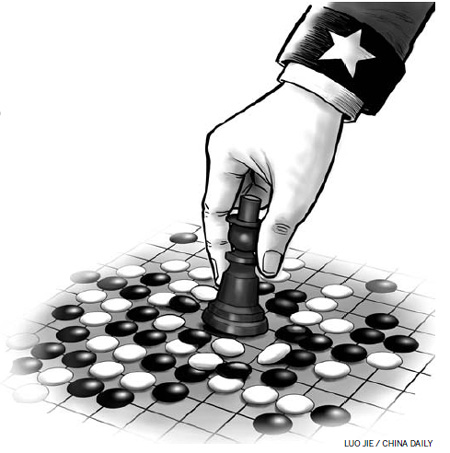
This year has also seen the Philippines and Vietnam adopting a tough stance over their territorial disputes with China. The US has consolidated its military presence in the Asia-Pacific region by using the "China threat" theory after China conducted the trial run of its first aircraft carrier. All these indicate that the South China Sea disputes will be the focus of Sino-US strategic competition.
In fact, most of China's neighbors, including the Philippines and Vietnam, have strengthened their armed forces and deepened their military cooperation with the US to "deal" with a rising China. Almost all the ASEAN member states are strengthening their armed forces and cooperating more closely with the US. Australia considers China the biggest military power in Asia, while Japan sees China as its main competitor in its defense program.
Though China has been reiterating that its defense policy is defensive, its neighbors are likely to continue increasing their defense budgets. So China and its neighboring countries need to deepen their mutual understanding on security to avoid being part of an arms race.
The earthquake in Japan in March this year and its reaction to the help that China offered reveal Tokyo's circular foreign policy. Its alliance with the US is at the core of Japan's foreign policy, while US allies, or Tokyo's "indirect allies" form the second circle, followed by Southeast Asian countries. In the fourth circle are Russia, India and Mongolia that can counterbalance China.
It is to be noted that countries in all the four circles have strategic interests in containing China. It is this circular foreign policy that prompted Japan to exercise great caution in accepting China's aid. In fact, Japan's selective acceptance of foreign aid is in accordance with its national strategy.
The earthquake in Japan, the floods in Thailand, rising terrorism in Afghanistan after the US announced the withdrawal of its troops and gang-related crimes along the Mekong River are some examples of non-traditional security challenges that the region and China face. And there are indications that such challenges will increase for China.
China will see significant changes in its security environment next year. First, the US, facing intensified competition, will continue its efforts to contain China by forming and consolidating its alliances. And second, since many countries and regions in Asia Pacific will go to the polls in 2012, their internal politics to a large extent will determine their foreign policies.
Not long ago, US Secretary of State Hillary Clinton announced the "US Pacific century" strategy, which is aimed at strengthening American presence in Asia. On the security front, the US will strengthen its alliances to check China's rise. On the economic front, it will further push the Trans-Pacific Partnership, an economic program with strategic considerations. The US intends to have more than its share of the fast economic growth in Asia; it hopes to take the lead in Asia-Pacific cooperation.
Washington participated in the East Asia Summit for the first time this year, and US President Barack Obama used the occasion to take a dig at China's peaceful rise. The US has become more involved in South China Sea disputes, too, especially in the dispute between China and the Philippines.
So a conflict between China, trying to defend its maritime interests, and the US, seeking strategic gains in the South China Sea, seems inevitable. Sovereignty is at the core of China's interests, and it will do anything to safeguard its maritime interests. Therefore, much will depend on the extent to which China's neighboring countries can accept reality.
Next year will also see many countries and regions holding elections. It is probable that new leaders will cater to their electorates by taking a stronger stance against other countries or regions, including China, which may create misunderstandings.
The elections could force the leaders to change their foreign policies, too, and diplomatic measures may not be effective enough to solve some of the thorny issues. That could pose a grave challenge to leaders and diplomats of all countries and regions in the Asia Pacific.
The authors are research scholars at the Institute of Asia-Pacific Studies, affiliated to the Chinese Academy of Social Sciences. This is an excerpt from the annual report to be released soon by the institute's Department of Security and International Relations.
 New type of urbanization is in the details

Copyright 1995 - . All rights reserved. The content (including but not limited to text, photo, multimedia information, etc) published in this site belongs to China Daily Information Co (CDIC). Without written authorization from CDIC, such content shall not be republished or used in any form. Note: Browsers with 1024*768 or higher resolution are suggested for this site.
License for publishing multimedia online 0108263 Registration Number: 130349