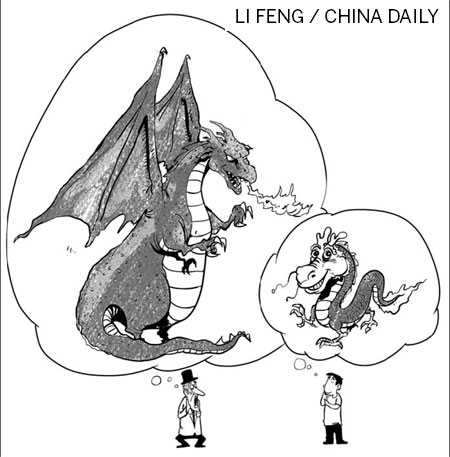
Had Siegfried or Beowulf not slain a European dragon but a Chinese long, those heroes would have committed an extraordinary crime. That's because the Chinese long is essentially a force of the good.
The long of China has a history (and etymology) of several thousand years and there are, according to linguist Michael Carr, more than 100 classical ones. Linguistically, it's a tragedy that many Chinese people, I mean the well-educated, English-speaking ones, are so readily prepared to call the long "dragons" - that's like voluntarily abandoning one's culture.
It is predicted that China will overtake the mighty United States in terms of the economy in a decade. Yet an ordinary Westerner has never heard about Lu Xun, doesn't know who Sun Wukong (the Monkey King) is, cannot tell a shengren from a junzi, has no inkling of Xi You Ji (The Journey to the West) or Hong Lou Meng (The Dream of Red Mansion), or any idea about the correct name for that mysterious creature that's lavishly showcased throughout the international media these days: the Chinese long.
A long is a long, maybe even a tianlong, but please, please do not use "dragon". That kind of linguistic imperialism happened to your unique Sichuan xiongmao once, remember? Now it's a Western "panda".
It's not like asking every expatriate to recite all Chinese mythical creatures like fenghuang, pixiu and qilin. Long is good enough already. Say it loud: l o n g - as in longing, longevity, or long time no see.
For too long, the West has engaged in cultural pseudo-studies, making everyone believe that the Chinese language (all languages, really) just transports Western meanings uttered in some inconceivable foreign tongue. The reality is, if cultural studies were science, the vocabularies of this world would add up, not overlap. Translation is something else.
In a recent article, I explained how European missionaries and philosophers conveniently translated shengren as "philosophers" or "saints", and messed up cultural China. It's one of the greatest errors in the history of Western imperialism, only comparable, perhaps, to Christopher Columbus calling the Native Americans "Indians".
Because of misleading translations, there are now "philosophers" and "saints" all over Asia, yet evidently there isn't a single buddha, bodhisattva or shengren in Europe. Think - what is that probability? Whose version of history are we taught?
Western caricaturists love to depict China as the European-style dragon: huge and red (of course), clumsy and pear-bodied, fierce, with tiny wings and a small flame. That clueless beast virtually sits there on the cover of some magazine waiting to be slain by journalist Siegfried Weischenberg, the World Trade Organization or the Barack Obama administration.
The truth is, the Chinese long are majestic, divine creatures, snake-bodied (snake is often called a xiaolong (xiao means "little" or small") and embody happiness, wisdom and virtue. In the West, on the other hand, it's a virtue to slay the dragon for a happy ending. If the European "dragon" had been on the Yellow Emperor's mind, what sort of people the "children of long" would have turned out to be?
See it from a Western perspective: the French have the cock, the Germans the eagle, the Americans the bald eagle ... and the Chinese a blinking "celestial dragon"! Of course, every sharp Western pen is trying to pick on the beast, and hurt it.
Cultures have preferences: Most Western kids love dinosaurs, the "terrible reptiles", because they think they are cute (compared to, perhaps, mythical dragons). In China, "dinosaurs" are called konglong, the terrible version of a mythical dragon. Or, how about this one: a drakon in Greek is a serpent of the seas, while a long in China is a serpent of the skies or the seas.
Some commentators argue that the "dragons" are now becoming cute and sociable in the West, too. About this, I have doubts. I believe that for Western children the empowering aspect of the dragon's physique and (fire-)power is utilized as a tool against one's foes; they feel like beast-taming dragon-riders. Look at Hollywood and the game industry.
In short, the European dragons haven't become friendlier at all, they just have been subjugated. As long as Westerners call the Chinese long a "dragon", they will project their own cultural ideas on China.
Yet, if they used the correct word, long, it would remind them that they are facing something culturally new. And, finally, they would also be able to say the names of China's beloved kungfu stars correctly: Bruce Lee (Li Xiaolong) and Jackie Chan (Cheng Long).
You must protect your traditions. This is true for all people. English as a global language is fine but, ideally, only if it accommodates all concepts and all cultures ever produced.
Embrace the differences and varieties of cultures and value those concepts that matter the most. Protect them. The long is precious.
The author is a German scholar at the Institute of World Literature of Peking University.
(China Daily 01/16/2012 page9)
 New type of urbanization is in the details

Copyright 1995 - . All rights reserved. The content (including but not limited to text, photo, multimedia information, etc) published in this site belongs to China Daily Information Co (CDIC). Without written authorization from CDIC, such content shall not be republished or used in any form. Note: Browsers with 1024*768 or higher resolution are suggested for this site.
License for publishing multimedia online 0108263 Registration Number: 130349