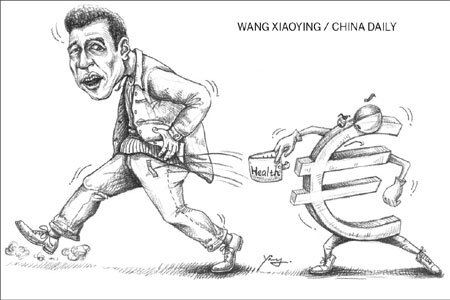
The deteriorating global economic outlook is increasing health experts' worries over the impact of the economic crisis on people's health. As the World Health Organization stated in 2009: "It is not yet clear what the current financial crisis will mean for low-income and emerging economies, but many predictions are highly pessimistic."
In low-income countries, economic crises lead to reduction in demand for imports - including medicines and medical supplies and technology - tighter access to capital and falling remittances from family members working overseas. In addition, there is less government revenue to finance health and social services.
A recent article in The Lancet, the world's leading general medical journal, highlights such effects in Greece, one of the European countries most affected by the ongoing global economic crisis. As a result, there has been a significant increase in unemployment, from 6.6 percent in May 2008 to 16.6 percent in May 2011. Even more troublesome is that unemployment among the youth in the same period increased from 18.6 percent to 40.1 percent.
Several studies have shown that unemployment increases the risk of both psychiatric and somatic disorders. For example, a strong correlation has been found between job loss and clinical and sub-clinical depression, substance abuse, anxiety and antisocial behavior. Also, several studies have shown that prolonged unemployment increases mortality rates.
In Greece, the rate of suicide increased by 17 percent from 2007 to 2009. During the same period, homicides and theft cases almost doubled. And in 2010, about 25 percent of the people who called a national suicide helpline complained of financial difficulties. The inability to pay huge amounts of personal debts may be one of the reasons why the number of suicides has increased - it rose a whopping 40 percent in the first six months of 2011 compared to the same period in 2010.
Besides, a surge in intravenous drug users could explain why HIV infections have increased more than 1,000 percent among them. Apart from intravenous drug use, prostitution and unsafe sex are also responsible for the increase in HIV infections, estimated to be 52 percent higher in 2011 than in 2010.
Although in Greece patients with social insurance can visit general practitioners free of charge or get medical treatment at outpatient clinics for a very low fee, fewer people visited them in 2009 compared to 2007. At the same time, there was a 24 percent increase in admissions to public hospitals in 2010 compared to 2009, while admission to private hospitals declined by 25-30 percent. This may be the result of a 40 percent cut in hospital budgets leading to understaffing and occasional shortages of medicines and medical supplies.
Another example of the effect of the economic crisis in Greece on vulnerable groups is the increased use of street clinics run by NGOs, such as the Greek chapter of Mdecins du Monde, which have reported that before the crisis only 3-4 percent people were seeking medical care from their street clinics but now the figure is 30 percent.
That people's health has worsened because of the crisis is demonstrated by the number of Greeks who consider their health to be "bad" or "very bad", which has increased by 14 percent from 2007 to 2009. To make matters worse, one-third of the country's outreach programs have been dropped because of budget cuts in 2009 and 2010.
By many accounts, the public healthcare system of Greece is riddled with corruption and inefficiency. Oftentimes, patients offer doctors informal payments to receive medical treatment, particularly when they are not covered by their social insurance fund. And hospitals frequently face shortages of materials and equipment.
The situation in Greece could be a harbinger of what may happen - or is happening - in countries with similar social and healthcare systems going through similarly difficult economic situations. The onus, therefore, is upon the governments of such countries to rationalize resources, increase efficiency and protect their most valuable asset: the health of their people.
The author is an international public health consultant.
(China Daily 01/18/2012 page9)
 New type of urbanization is in the details

Copyright 1995 - . All rights reserved. The content (including but not limited to text, photo, multimedia information, etc) published in this site belongs to China Daily Information Co (CDIC). Without written authorization from CDIC, such content shall not be republished or used in any form. Note: Browsers with 1024*768 or higher resolution are suggested for this site.
License for publishing multimedia online 0108263 Registration Number: 130349