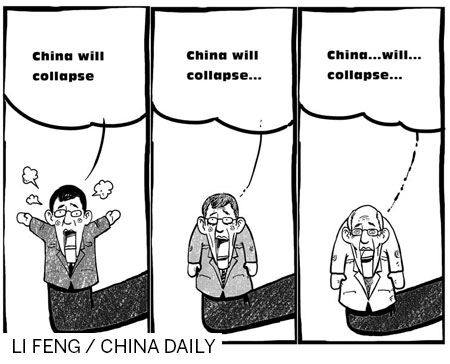
Despite being repeatedly proved wrong, proponents of the "China collapse" theory have been using it to win their share of the market. A recent article by Gordon G. Chang in Foreign Policy, a bimonthly US magazine, is one such example.
Even though there is nothing truly "revolutionary" in Chang's arguments and predictions, some Western politicians, media outlets and scholars are attaching extraordinary importance to him. In his book, The Coming Collapse of China, Chang predicted that China would "collapse" in 2006. When he saw China was not only still there, but also developing at an accelerated rate, he modified his "prophecy" slightly, giving the country a few more years to live - until 2011.
This is 2012, and I have just left China (Beijing, to be precise) after spending a wonderful few days there. The country looked far from collapsing. In fact, it is thousands of miles away from most Western capitals with their angry, dissatisfied crowds frustrated by social malaise. Obviously realizing that China has once again defied his sour predictions, Chang apologized to his readers and deferred the doomsday scenario to 2012.
Here are some arguments to show how unoriginal Chang's offerings are, at least from the point of view of the Western conservative mainstream: "The global boom of the last two decades ended in 2008, China, which during its reform era had one of the best demographic profiles of any nation, will soon have one of the worst. The Chinese workforce will level off in about 2013, perhaps 2014 a trend that will eventually make the country's factories uncompetitive" Above all, Chang argues: "China's 'sweet spot' is over because, in recent years, the conditions that created it have either disappeared or will soon."
What is fascinating is that Chang is actually redefining what is conservative and what is progressive to suit his political and ideological goals. He calls pro-business reforms "progressive" and sees the recent reforms in China, which are expected to benefit people, as most negative.
What Chang and his ilk find most threatening is the looming re-establishment of "barriers to international commerce". To make it clear, the welfare of Chinese people does not matter one bit to them. What is important for them is the access of Western companies to the Chinese markets. Eminent American linguist, cognitive scientist and activist Noam Chomsky calls it "profit over people".
Chang is forgetting that we are living in the 21st century, which is marked by the "rebellion" of countries previously bullied by the West. These countries are now successfully pursuing their own political and economic models - Venezuela, Bolivia, Argentina, Ecuador and others. In Europe and the United States, the majority of the people are disgusted with pro-market fundamentalism that has kidnapped their nations, but they cannot do much to change the system. They are searching for alternatives, looking at Latin America and China, but also at homegrown options.
If anything is collapsing, it is the group of nations governed by market fundamentalism.
China and Latin America are, thank you, just fine: both economically and psychologically. They are growing at astonishing rates in an era of sluggish global growth not to satisfy some business entities but to improve the lives of their people. For them, economy and trade are the means, not the end.
This spirit of unity, solidarity and enthusiasm is exactly what makes China successful and unstoppable. It is also what makes its enemies desperate and confrontational in anticipation of defeat.
There is no doubt that the Communist Party of China and the Chinese government will thrive in and after 2012. But China and its people should be aware of and vigilant against the dangers they face from outside: reports like those prepared by right-wingers are not just miscalculated predictions. They are well-planned targeted attacks against the Chinese system, an attempt to destabilize the country, to confuse its people, to break their zeal of building a prosperous society.
It goes without saying that the majority of Chinese people want social justice. They want to build an egalitarian and prosperous country, for themselves and for their children. Reforms in China are a logical response of the government to the desires of the people. Such a process is called democracy, which actually translates into "the rule of the people", not "the Western-style political system".
As long as China is united in building a better and just society, it will be around not only at the end of this year, but also for centuries and millenniums to come. In the future, Chang and his followers and other proponents of China's collapse will make and modify their well-financed but futile predictions.
The author is an American novelist, documentary filmmaker and investigative journalist.
(China Daily 01/30/2012 page9)
 New type of urbanization is in the details

Copyright 1995 - . All rights reserved. The content (including but not limited to text, photo, multimedia information, etc) published in this site belongs to China Daily Information Co (CDIC). Without written authorization from CDIC, such content shall not be republished or used in any form. Note: Browsers with 1024*768 or higher resolution are suggested for this site.
License for publishing multimedia online 0108263 Registration Number: 130349