Foreigners may scratch their heads in wonder at the world's largest annual human migration, as more than 300 million Chinese people travel to and fro to celebrate the lunar new year.
I still remember my first experience of Spring Festival travel. In 1982 I took a four-day train ride from Beijing to the Gansu-Xinjiang border to take a jeep to a new oilfield in the Qaidam Basin. Even then it was bedlam. I can clearly recall a woman at Luoyang station thrusting her baby at me through the window so she could wrestle her way onto the train.
Thirty years have passed, but Spring Festival is still the same for many Chinese people: head home, reunite with family, share food and exchange gifts, and then try to get a ticket back to work. Perhaps the more people change the more they want reassurance that some things remain the same.
Three decades ago, a watch, a bike and a radio were the prerequisites for a wedding. A "Seagull" watch of 50 yuan ($8) or a "Flying Pigeon" bicycle of about 100 yuan was enough to prove the owner's wealth and taste.
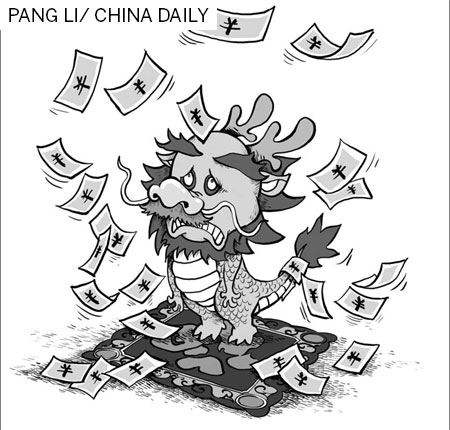
Now an imported luxury watch is de rigueur for many. Shanghai now has a "Millionaires' Exhibition" simply promoting top-shelf items that might be the playthings of millionaires, from extravagant jewelry to private helicopters. But even the designer stores in the big cities do not seem based on the reality of most ordinary people. Many micro-bloggers have complained that the red envelopes containing lucky money that they gave to children this year were "bigger" than those of last year and that the lucky money is becoming a big burden. One 10-month-old baby in Changchun was reported to have received more than 20,000 yuan of lucky money from his grandparents and other relatives during the Spring Festival.
So the lunar new year and returning home raises the question: How to convey love? What are life's priorities? Is it the material world, measured in dollars and brand names, or in the intangible feelings for loved ones, for the deep bonds that last a lifetime from generation to generation? While the latter seems right to many, the commercial media convey the message that it is the former that is the key to happiness.
Yet the core Chinese beliefs teach admiration of the natural, and contentment in humility. Buddhism with its espousing of a simple life runs deep in many hearts. Daoist philosophy turns materialism on its head. But against these strong, millennia-old undercurrents, many modern Chinese are bombarded with the message that they should accumulate and display material wealth. Peer pressure can be overwhelming, and failure to comply can result in rejection from social circles. If the boyfriend has a bike and no car, the girl will soon be looking elsewhere. Especially if the boy prefers pedaling as it is more environmentally friendly, and shows no inclination to borrow big to acquire horsepower and gas. On top of the social pressures, big increases in domestic consumption are recommended by most policy advisors, as a way to maintain high growth in the face of slowing exports. In the stampede for possessions a faint refrain can be heard coming from the government saying that society should be modestly "relatively well-off".
With the foundations of Chinese society, the Confucian values of family, loyalty and moderation, overlaid with rocketing wealth and technological advances of over a quarter century, the Chinese new year increasingly looks like a time-warp mirror. I Facebooked my eldest son in California pondering what seems like the tenuous generational links in our family, but he said my dad was always with him, and all that he had learned from him was as straight and as true as "a flick pass from Alfie Langer", a reference to a legendary Rugby League halfback in Australia.
Chinese people have their new year to renew generational strengths, and they do it in style, and maybe overdo it, but I believe we can take a lesson from this and reflect on what's important for family.
The author is an Australian researcher collaborating with Chinese academic and commercial institutions.
(China Daily 01/31/2012 page9)
 New type of urbanization is in the details

Copyright 1995 - . All rights reserved. The content (including but not limited to text, photo, multimedia information, etc) published in this site belongs to China Daily Information Co (CDIC). Without written authorization from CDIC, such content shall not be republished or used in any form. Note: Browsers with 1024*768 or higher resolution are suggested for this site.
License for publishing multimedia online 0108263 Registration Number: 130349