China-Africa ties over the past three decades have yielded magnificent results, characterized by frequent high-level political visits, strengthened economic and trade relations and burgeoning bilateral socio-cultural communications.
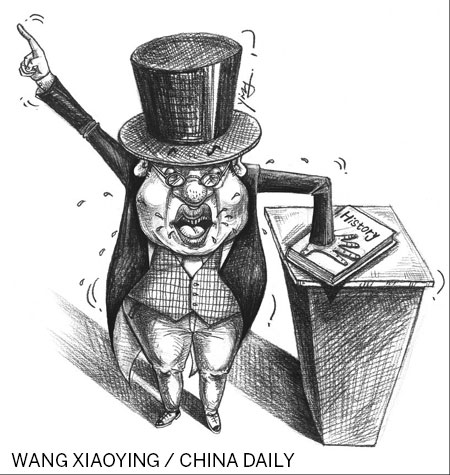
But some Western countries and their media have been trying to drive a wedge between China and African countries, posing a potential threat to the harmonious development of Sino-African relations.
Western critics use the following viewpoints to justify their actions: First, Chinese investments flow into only Africa's mining industries or into countries with abundant natural resources. Second, Chinese enterprises do not fulfill their social responsibilities. Third, Chinese investors prevent their skills and technologies from being passed over to African societies. And last, the continuous influx of Chinese products to Africa is detrimental to the industrialization and modernization of the continent's countries.
The history of Sino-African relations would be the best testimony to prove these criticisms are absurd and groundless. Even though Sino-African ties have diversified greatly in content since the 1980s, there has been no change in their basic feature of equality and reciprocity.
In 2011, China's direct investment in Africa was $1.7 billion, spread over fields such as commerce, agriculture and infrastructure construction - and, contrary to what the West says, it was not restricted to natural resources. The minerals and petroleum that China imports from African countries every year comprise less than 10 percent of the continent's total output, while the ratios for the United States and the European Union are more than 30 percent.
If China, a small stakeholder, were to be blamed for denuding Africa of its natural resources, how can the West, the big player that it is, be exempted from the same criticism?
As far as social responsibilities are concerned, Chinese enterprises have never been wanting.
Take PetroChina's refinery plant in Khartoum, Sudan, for example. PetroChina has provided local people with a beautiful artificial lake and an oasis, and spent huge amounts on its sewage treatment plant. The company also attaches great importance to donations; it donates funds to local hospitals and schools every year, and has earmarked a special budget to support collaborations in personnel training, technology and research and development with Sudanese universities.
China's detractors seem less interested in the severe environmental problems caused by Western oil companies such as Shell, ExxonMobil, Chevron and Total in the Niger Delta in Nigeria and Cabinda of Angola.
China lays special emphasis on capacity building in its relations with Africa. It has helped train more than 30,000 specialists and sponsored more than 30,000 students from Africa. It sends experts on medical services, and agriculture development and infrastructure building missions to African countries every year, too. The Chinese experts help their African counterparts with their technologies and skills. Also, many Chinese enterprises, following the policy of localization, recruit African employees, providing them both with work and skill training.
Regarding the development of African countries, the Chinese government spares no effort in promulgating supportive policies. What is of utmost importance is that China does not attach political or economic strings to its promises, reflecting that it respects the development modes that African countries have chosen.
As a matter of fact, China has been targeted mainly because some Western powers fear that its engagement with Africa would result in the decline of the West's traditional hegemony in the continent and not because they care for African countries' development.
In a sense, the condemnations of and attacks against China could be defined as ideological propaganda to justify the West's actions against its antagonists. The logic is evidently an offshoot of the Cold War mentality, which assumes, erroneously though, that Sino-Western relations in Africa are still zero-sum games rather than dialogues and cooperation.
The Western hype over China's "misbehaviors" in Africa has made China determined to further ameliorate its ties with the continent's countries.
The development of the Chinese mass media lags far behind its economic and political development. This would explain why Chinese are often silent when people from other countries, including some from Africa, misinterpret or even attack China for its benign and beneficial role in Africa. To make the rest of the world aware of China's role in Africa, the Chinese mass media have to break the monopoly of their Western competitors in Africa and spread the facts, as well as the views of the Chinese government and think tanks across the world.
Besides, the Chinese government should pay close attention to the problems that could crop up in the interactions between the increasing number of Chinese in Africa and the local people.
This is very important to guarantee the sustainable development of Sino-African relations in the long run.
The author is a research scholar at the Graduate School of the Chinese Academy of Social Sciences.
(China Daily 02/01/2012 page9)
 New type of urbanization is in the details

Copyright 1995 - . All rights reserved. The content (including but not limited to text, photo, multimedia information, etc) published in this site belongs to China Daily Information Co (CDIC). Without written authorization from CDIC, such content shall not be republished or used in any form. Note: Browsers with 1024*768 or higher resolution are suggested for this site.
License for publishing multimedia online 0108263 Registration Number: 130349