China needs to solve the problems of migrant workers and provide them every possible help to become permanent members of cities
According to the 2011 data released by the National Bureau of Statistics, China's urban population has reached 51.27 percent of the total, thus exceeding the rural population for the first time in history.
This is a critical point for China's urbanization. From now on, China needs to promote both the quality as well as the quantity of urbanization. For that purpose, the emphasis should be put on making rural people true urban residents, not simply introducing them to cities.
The greatest challenge for this is the problems of migrant workers, whose number has reached 242 million and is still growing. It is their labor that has made China's urbanization possible: a recent survey shows that migrant workers contribute 34 percent to the urbanization of Beijing and 30.6 percent to that of Shanghai, providing most of the labor for sectors such as construction.
But, though the cities have been built on the sweat of their labor, these workers are not formal residents of the cities they toil in. This is because their hukou, or permanent residence permits, are not registered there. We have already heard too many sad stories about migrant workers being discriminated against by urban residents and we do not want to hear more.
The following is an incomplete list of basic public services that exclude or partly exclude migrant workers: compulsory education, pension, medical insurance, lowest living standards insurance and public housing.
The result of such discrimination, which widens the gap between migrant workers and urban residents, has already caused mass incidents in provinces like Guangdong. Urban administrators need to help improve migrant workers' lives to prevent similar incidents in the future.
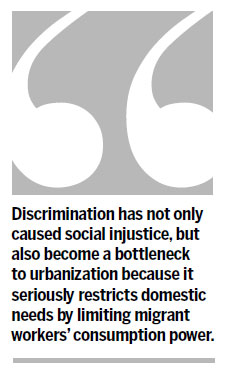
Such discrimination has not only caused social injustice, but also become a bottleneck to urbanization because it seriously restricts domestic needs by limiting migrant workers' consumption power. A 2010 research shows that the average Engel's coefficient - which measures the percentage of a household's expenditure on food to its total spending - of migrant workers is more than 50 percent, which seriously restricts both the willingness and the ability to consume, in turn curbing domestic demand.
Therefore, to further propel urbanization, China needs to solve the problems of migrant workers by helping them become permanent members of the cities in which they live, with equal access to public services and benefits.
The central government addressed the problem in its 2011 Central Economic Work Conference. In its concluding document, the conference claimed it would orderly guide qualified migrant workers to become permanent urban residents, and solve their education, healthcare and housing difficulties. That is a praiseworthy move for it might break the barrier between urban and rural residents.
In fact, many regional governments have already taken measures to include some migrant workers into their public service systems. For example, many counties in Guangdong and Zhejiang provinces and Shanghai have already started to let migrant workers enjoy endowment insurance like local residents. Some other cities like Nantong in Jiangsu province have also tried to offer public housing to migrant workers.
But to really address the issue the hukou system, the fundamental mechanism of China's urban-rural division, must be reformed to finally end these inequalities. However, local governments cannot make great progress in this regard, as the power to totally reform the hukou system belongs exclusively to the central government. The central government mentioned the problem in 2009 and reiterated it in 2011, but it needs to do more in the future to provide support for such reforms.
While gradually altering the division, the cities also need to change other discriminative policies to diminish the differences between local residents and migrant workers. And more importantly, they need to provide equal education opportunities for the children of migrant workers, for that will prevent inequality from being inherited by the next generation.
Of course, turning migrant workers into true urban residents is a huge program that involves the interests of tens of millions of people, so we cannot expect it to be done all at once. The problems can only be solved step by step, with priority given to those with the most urgent needs.
Metropolises such as Beijing and Shanghai already have extremely large populations, so it is important to guide the population flow into small and medium-sized cities.
But to ensure China's urbanization proceeds smoothly the State needs to take measures to honor its promise of helping turn migrant workers into true urban residents.
The author is a researcher on urban development at the National Development and Reform Commission. The Chinese text first appeared in China Development Observation magazine.
(China Daily 02/11/2012 page5)
 New type of urbanization is in the details

Copyright 1995 - . All rights reserved. The content (including but not limited to text, photo, multimedia information, etc) published in this site belongs to China Daily Information Co (CDIC). Without written authorization from CDIC, such content shall not be republished or used in any form. Note: Browsers with 1024*768 or higher resolution are suggested for this site.
License for publishing multimedia online 0108263 Registration Number: 130349