China, together with Russia, vetoed a United Nations Security Council resolution on Feb 4 , which urged Syrian President Bashar al-Assad to step down after months of riots, because it seeks a political and peaceful resolution of the Syrian crisis.
China's veto drew worldwide attention, with Western politicians and media taking the lead in criticizing its move. For example, UK Foreign Secretary William Hague accused China and Russia of "betraying the Syrian people" by vetoing a UN resolution condemning the violence. "In deploying them, they have let down the Arab League, they have increased the likelihood of what they wish to avoid in Syria, civil war, and they have placed themselves on the wrong side of Arab and international opinion," he said.
China is a large but responsible country with an independent foreign policy, which means it cannot follow the United States and its Western allies. China's peaceful foreign policy is aimed at building a harmonious world, based on the Five Principles of Peaceful Coexistence, and resolving conflicts and clashes between countries through negotiations. Its foreign policy initiatives are unfolding on the basis of the same principles, and its stance on Syria is no exception.
China has maintained communication not only with the Syrian government, but also with the Syrian opposition. For example, it has invited Syrian opposition representatives to Beijing for talks. It is using all possible means to promote a political solution in Syria and making efforts to stabilize the situation to prevent a full-fledged civil war. Therefore, China's foreign policy is beyond reproach.
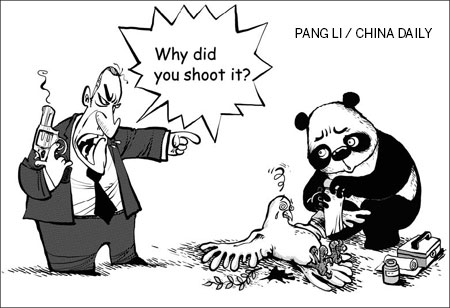
The problem is that the US and some Western countries are trying to use a UN Security Council mandate to replicate the "Libya model" in Syria. Despite some Western diplomats' pledge ruling out foreign military operation, the resolution, if passed, would have given Western powers the chance they needed to intervene militarily in Syria. And once the Western powers directly intervene in Syria, the country will become another "Libya", which would not only push it into a "dirty" war, but also cause turbulence in the whole of the Middle East.
The world knows that the UN Security Council did not authorize a military strike against Libya; it only imposed a "no-fly zone". But the US-led Western countries used the UN resolution as an excuse to launch indiscriminate bombing on Libya.
There is no reason to believe that the US and its Western allies are interested in safeguarding the interests of the people in the Middle East and, hence, are unhappy with China for altogether other reasons.
After the end of the Cold War, the US embarked on a "two-ocean strategy". So, it has been using the eastward expansion of NATO to achieve its strategic objectives in the Euro-Atlantic region. And in the Asia-Pacific region, it depends on the US-Japan Security Treaty, the new Guidelines for US-Japan Defense Cooperation and the establishment of the Theater Missile Defense System to maintain its sole superpower status.
The Middle East serves as a junction in the global power structure and can create a strong "dumbbell pattern" to reinforce Washington's "two-ocean strategy". That's why despite gradually shifting its strategic focus to the Asia-Pacific region, the US has not changed its "two-ocean" and "dumbbell pattern" strategy. How can the Middle East not be an important part of the US' global strategy?
Shortly after the end of the Cold War, Western countries led by the US launched a series of plans to transform the Middle East. These plans included the 1995 "Barcelona Process" of the European Union and the 2008 "Mediterranean Union" of the Mediterranean Summit.
The US National Security Strategy 2002 stressed the importance of sustaining the US' unparalleled status in the world, promoting democracy worldwide and taking preemptive military action against terrorists and tyrants.
In 2004, the US officially introduced the concept of a "Greater Middle East". Under this plan, Washington wanted to group its Western allies to promote political, economic, social, cultural and educational transformation in the Middle East in more than 10 years. Some American scholars believe that the "Greater Middle East" plan looks exactly like the 1975 Helsinki Accords, which 35 Western countries had signed to promote changes in the Warsaw Pact.
The wars in Afghanistan and Iraq are part of Washington's "Greater Middle East" plan. Since it could not succeed in Afghanistan and Iraq, the US is using the Middle East political crisis to transform the region to its own liking, and the "Libya model", which it has tried to use in Syria, is part of its wider plan.
In fact, the US-led fresh sanctions against Iran, too, are part of that plan. Many people may not know that it was the US and other Western countries that actually helped Iran develop nuclear projects when Mohammad Reza Shah Pahlavi was in power in the country. But now they are afraid of reaping what they have sowed.
The West has been a failure in Afghanistan, Iraq and Libya as far as improving the quality of people's life is concerned. Most people in these countries are suffering the consequences of the ongoing turmoil and bloodshed, and living in fear and misery because of Western intervention. There is no reason why Syria should be like them and why the Middle East should continue be volatile.
Given the facts, it is not surprising that the US and its Western allies find fault with China's policy. That would not have been the case had China joined the league of self-seeking Western countries and supported the US' policy on the Middle East. China faces criticism because it refuses to be a pawn in the wheeling and dealing of the West.
This is precisely why China should be prepared to encounter difficulties and challenges, including criticisms from the West, on the road to peaceful development. It should also be prepared to take them on and keep pursuing peace and harmony.
The author is a researcher in Middle East Studies at the Chinese Academy of Social Sciences.
(China Daily 02/15/2012 page9)
 New type of urbanization is in the details

Copyright 1995 - . All rights reserved. The content (including but not limited to text, photo, multimedia information, etc) published in this site belongs to China Daily Information Co (CDIC). Without written authorization from CDIC, such content shall not be republished or used in any form. Note: Browsers with 1024*768 or higher resolution are suggested for this site.
License for publishing multimedia online 0108263 Registration Number: 130349