Urbanization and restructuring will boost residents' spending and promote more sustainable development
It is China's short-term policy goal as well as its medium and long-term strategic aim to reverse the imbalance between investment and consumption as soon as possible and establish a consumption-dominated development pattern.
China's economic prospects will to a large extent be decided by how successful it is in achieving the transformation to a consumption-dominated development pattern. If the process is smoothly pushed forward in the coming five to 10 years, it will have historical consequences for the country's successful medium and long-term development and will play a big role in promoting global economic rebalancing, recovery and growth.
China's economy is expected to continue growing in the coming decade, despite the probability of continuing turbulence and contraction in the international market. In the short term, investment is still likely to spur the country's economic growth, but investment can only be a long-term driver for growth if it is effectively converted into consumption. So short-term investment must serve medium and long-term consumption. Any investment that sacrifices consumption will damage the internal driving force for economic growth and will only add to the country's economic uncertainties in the long run.
The country can maintain economic growth of around 8 percent in the next two decades if it manages to fully tap its consumption potential. For example, by raising its consumption to GDP ratio to more than 60 percent and lowering the investment to the GDP ratio to less than 40 percent.
If the consumption ratio remains at the level it is now, or maintains its downward tendency, the country will have difficulty in attaining medium and long-term 8-percent economic growth even if its economic growth is boosted in the short term.
The outstanding structural problems are mainly concentrated on the imbalance between investment and consumption. This makes it necessary for the country to adjust its industrial structure to better adapt itself to the ongoing changes in its consumption structure. In so doing, the country can take a big step toward boosting the development of its service sector.
The next five to 10 years will be a critical period for China and it must push for a consumption-dominated transformation of its economy. Internal and external changes have added pressures to China's development, and the development bottlenecks produced by its long-standing reliance on an investment and export-driven growth model have become increasingly obvious.
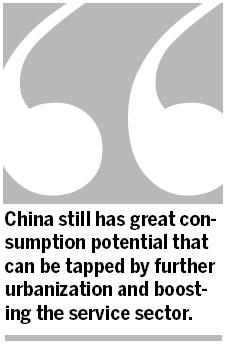
Encouragingly, China still has great consumption potential that can be tapped by further urbanization and boosting the service sector. The country's urbanization ratio is expected to increase by 10-15 percentage points in the next decade, which, together with an estimated increase of 15-20 percentage points in the service sector, will create an enormous consumption market that will boost the country's development.
The ratio of China's service sector is only 43 percent of its GDP, far lower than the world's average of 60 percent, meaning there is room for rapid expansion in the years ahead.
It will be a medium and long-term process for China to change its development pattern from investment and export-led growth to consumption-led growth, and the process will require a series of policy adjustments and arrangements.
As the first step, the country should boost its final consumption ratio to 55 percent from the current 47.4 percent in the coming five years. Then it should boost the ratio to more than 60 percent in the five years after that.
In its 12th Five-Year Plan (2011-15), China vowed to expand domestic demand and further tap residents' consumption potential. The key to realizing this goal is the establishment of a consumption-dominated strategy and further reforms which lay a solid foundation for narrowing the wealth gap and improving people's livelihoods, and which help to promote sustainable development. Such development should prioritize green growth, market-regulated activities and governance transformation in the decades ahead.
The author is director of the Hainan-based China Institute for Reform and Development.
(China Daily 02/28/2012 page8)
 New type of urbanization is in the details

Copyright 1995 - . All rights reserved. The content (including but not limited to text, photo, multimedia information, etc) published in this site belongs to China Daily Information Co (CDIC). Without written authorization from CDIC, such content shall not be republished or used in any form. Note: Browsers with 1024*768 or higher resolution are suggested for this site.
License for publishing multimedia online 0108263 Registration Number: 130349