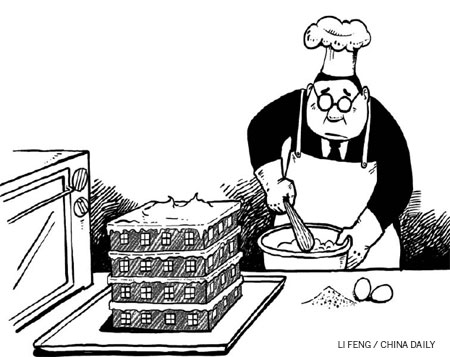
China's housing market has come to a crossroads. While there is a high expectation that housing should be more affordable, with rapid urbanization increasing the demand for housing the real challenge is the provision of housing for the medium and low-income population. The issue of housing is thus being hotly discussed in the ongoing annual meetings of the National People's Congress and the Chinese People's Political Consultative Conference.
Dwindling land revenues have exerted great pressure on the local fiscal base, which has been so far heavily reliant on land sales. The income of land sales in Shanghai dropped by 70 percent year-on-year in January and in Guangzhou it fell by 90 percent. Even Beijing's income from land sales was only one-third that of last year. Meanwhile the debt-burdened local investment platform is facing the maturity of loans, which is increasing the financial pressure on local governments.
Faced with this pressure, local governments under the disguise of "policy fine-tuning" have tried to introduce some de facto relaxation of the central government's tough property restrictions. These have been immediately denounced by the central government, which is determined to maintain control and deflate the real estate bubble.
In the long run, reforming the local government tax base and developing a system of guaranteed housing from multiple suppliers is necessary to meet the demand of the middle and low-income population. At present, the guaranteed-housing system comprises affordable housing, fixed-price housing, low-rent housing and social rental housing. So far the attention has focused on the provision of affordable housing. But constructing affordable housing in concentrated areas may lead to future social exclusion, a problem witnessed in more developed market economies. To develop a system of guaranteed housing provision that can meet the country's future housing needs, further reforms are required.
With the vacancy rate estimated to be 40 per cent in many cities, there is clearly an excess of upper-market commodity housing. This reflects the structural root of the housing problem, which is caused by social inequalities and stratification. Thus a related question is how to expand rental housing to include vacant properties owned by speculators.
Levying property taxes would increase the cost of holding vacant properties. In a stable property market, speculative investors in housing have no incentive to hold unused properties when the rent levels are low as they do not receive an adequate return on their investment. On the other hand, property owners may not wish to rent out their properties because of various concerns and practical difficulties. To facilitate the development of the private rental market, it is thus feasible to establish a dedicated company of social landlords to manage these vacant properties while returning a reasonable share of the rent to owners. This submarket of private rental housing would consist of mainly good quality commodity housing and thus would be able to meet the housing needs of the upwardly mobile urban population who lack the means to purchase an equivalent property.
In fact there is already a buoyant rental market that caters to the demand of rural migrants. This market has been created in the villages on the outskirts of urban centers where collectively owned land has been leased to private developers to construct apartment buildings which accommodate the low-income urban population such as new graduates and young white-collar workers. The developers can recover their costs in two or three years. At present, because of policy restrictions, this market operates in a speculative manner, seeking to make as much profit as possible before the government enforces demolition. Instead of demolishing urban villages on a large scale and enforcing the upgrading of informal housing to modern high-rises, the government could pay more attention to regulating it and treating these private developers as social landlords. Enforced upgrading inevitably leads to rent inflation.
Looking back, we can see some significant changes in the role of the State in housing provision. The first Asian financial crisis led to the suspension of in-kind housing support and the State's retreat from housing provision. The global financial crisis caused the inflow of speculative investment in housing. Both triggered property booms and price rebounds. Recognising the economic risks and social discontent, the government aims to take much of responsibility for a guaranteed housing system, in particular the provision of affordable housing.
But even though developing a system of State-guaranteed housing is a laudable objective, the dwindling land-based revenue of local governments will make that difficult, therefore there is a need to expand the provision of affordable housing through multiple channels.
The author is Bartlett Professor of Planning, University College London.
(China Daily 03/09/2012 page10)
 New type of urbanization is in the details

Copyright 1995 - . All rights reserved. The content (including but not limited to text, photo, multimedia information, etc) published in this site belongs to China Daily Information Co (CDIC). Without written authorization from CDIC, such content shall not be republished or used in any form. Note: Browsers with 1024*768 or higher resolution are suggested for this site.
License for publishing multimedia online 0108263 Registration Number: 130349