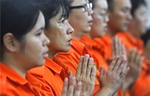
Upcoming summit in Seoul will explore ways to combat and prevent radiological terrorism in Northeast Asia
The second Nuclear Security Summit will be held in Seoul on March 26-27, 2012. The event provides an opportunity for China, Japan and the Republic of Korea to develop concrete cooperation on nuclear security.
The issue of nuclear security has a very different nature than most other international security issues. In normal security issues, if one country enhances its security capability, its neighbors may begin to feel threatened and therefore develop countermeasures, these competitions eventually result in a security dilemma. The goal of nuclear security on the other hand, is to stop nuclear terrorism, an enemy of all countries. Improving nuclear security in one country benefits not only that country but others as well.
To better work with one another, the participants of nuclear security summits try not to put controversial topics in the agenda. For example, the first Nuclear Security Summit did not invite Israel and it did not discuss the Iranian nuclear issue. While the upcoming summit will not include the Democratic People's Republic of Korea nuclear issue on the agenda. Such arrangements encourage the participants to develop cooperation in nuclear security although they may not agree with one another on other security issues.
China, Japan and the Republic of Korea are in geographical proximity in Northeast Asia and are economically dependent on each other. The radiation leaks at the Fukushima Daiichi nuclear plant as a result of the tsunami last year should remind us that a nuclear accident in any of the three would automatically hurt the other two. A successful terrorist attack on a nuclear plant would in all likelihood have consequences of even greater severity than those arising from the Fukushima crisis.
So, even though they may have disputes on economic and other security issues, the three countries should work together to prevent any terrorist attacks on nuclear facilities in this region.
The coming Nuclear Security Summit in Seoul will provide momentum for China, Japan and the Republic of Korea to share their experiences and information and discuss their threat perceptions and ways to increase cooperation in nuclear security.
There are four categories of nuclear terrorism: stealing nuclear weapons, stealing fissile material for nuclear weapons, dispersing radioactive material and attacking nuclear facilities. While US experts worry more about terrorists stealing fissile material for nuclear weapons, experts in East Asia worry more about terrorists dispersing radioactive material and attacking nuclear facilities, in short, radiological terrorism.
Threat assessment and perception is a fundamental issue, as it tells the government how to allocate resources, how to fix loopholes in the security system and how to respond to emerging nuclear security challenges. It is important for experts in China, Japan and the Republic of Korea to better understand how their counterparts in their neighboring countries and in the United States make risk assessments. Especially, they should know whether the differences and similarities in these threat assessments come from factual reasons or cultural reasons. Based on accurate threat assessments, the East Asia countries can therefore develop effective nuclear security systems. The experts from China, Japan and the Republic of Korea should launch discussions on their threat assessments after the summit and discuss them with their American counterparts.
Nuclear terrorism may involve cross-border activities, for example, illicit trafficking of fissile and radioactive materials, so information sharing among governments is necessary to prevent cross-boarder terrorist activities. China, Japan and the Republic of Korea are all signatories of the International Convention for the Suppression of Acts of Nuclear Terrorism and Japan and China have ratified the convention. The core function of the convention is to criminalize nuclear terrorism. According to the convention, the parties should treat any nuclear-terrorism activity as a crime in their domestic laws.
The three countries have bilateral agreements with each other on legal assistance in criminal matters. So, the three governments can use the channels of legal assistance in criminal matters to share information about nuclear terrorism activities. Once a government discovers plans for a nuclear terrorist attack, it should inform the other two and the three countries should work together to prevent the crime. The existing cooperation among the three countries in legal assistance is useful to fight against nuclear terrorism in the region.
All three countries may have already accumulated some experience in fighting nuclear terrorist attacks. If so they should share their experiences with each other, as it will enable the other countries' personnel to better respond to similar threats. The three countries are also building new training centers to train new nuclear security forces, so they could also consider exchanges of syllabi, faculty and trainees.
Today East Asian countries are so closely linked and dependent on one another, no matter how much we disagree with each other on some other matters, we should help each other on nuclear security. The coming Nuclear Security Summit will enable China, Japan and the Republic of Korea to explore effective cooperation, which should also include the Democratic People's Republic of Korea in the future.
The author is professor of international relations at Tsinghua University and senior associate of Carnegie Endowment for International Peace. The article is based on a paper he wrote for Asian Institute.
(China Daily 03/20/2012 page8)
 New type of urbanization is in the details

Copyright 1995 - . All rights reserved. The content (including but not limited to text, photo, multimedia information, etc) published in this site belongs to China Daily Information Co (CDIC). Without written authorization from CDIC, such content shall not be republished or used in any form. Note: Browsers with 1024*768 or higher resolution are suggested for this site.
License for publishing multimedia online 0108263 Registration Number: 130349