Urbanization is an essential element of economic development. Cities and towns constitute a country's economic, social and cultural backbone, provide economies of scale, and attract the skills and knowledge needed to push development to a higher level.
In China, the trend toward urbanization has been both remarkable and challenging. Remarkable, for the sheer speed at which it has occurred, and challenging for the many problems that are accompanying it: environmental degradation, inadequacy of municipal and social services, and increasing inequality, to name just a few.
A recent study by the Asian Development Bank and the National Development and Reform Commission estimates that cities in China will grow by about 15 million people each year and by a total of 230 million over the next 15 years. That's equivalent to adding nearly the entire population of Indonesia today.
There are concerns about the impact on the future form, livability, and environmental quality of Chinese cities. The urbanization policies outlined in the 12th Five Year Plan (2011-15) will have profound implications for the country's economic and social development far into the future. And decisions made now on urban development and natural resource management will have wide-ranging consequences not only in China, but across Asia and indeed globally.
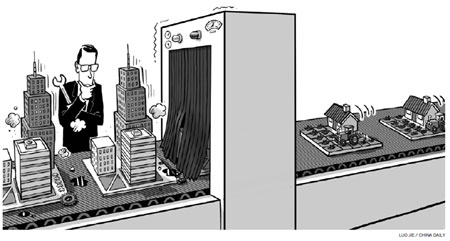
For decades, rapid industrial growth has driven urbanization in China's manufacturing and export centers, especially along the eastern seaboard. Development of industrial land was essential for attracting investors. That is all changing now. As regional transport networks are expanding, the rising cost of labor in eastern cities is pushing many manufacturers to the center of the country. On the other hand, coastal cities are increasingly oriented toward research and development, commerce, and services, an evolution that has very different land and infrastructure requirements.
Eastern cities will have the opportunity to revitalize existing urban areas as heavy industry moves out, while central and western cities can apply green development principles as they expand. How these cities develop over the next five to 10 years will have long-term implications for their economic and social development, land management, consumption of natural resources, energy needs, transport, pollution, greenhouse gas emissions, and urban livability in general.
The country's economic transformation and regional development strategies are now reshaping cities in all regions. These strategies are examined in "Strategic Options for Urbanization", an ADB-supported policy study being prepared by the National Development and Reform Commission. The study emphasizes the need for improvements in the social safety net for migrant workers living in urban areas. Based on a series of pilot projects in health and education services, social insurance, and social housing, the study recommends harmonizing access to social benefits for all urban residents, regardless of where they are registered.
Over the last 20 years, the Asian Development Bank has been providing loans, grants and technical assistance to China in support of improvements to the urban environment, such as drinking water supply, wastewater treatment, flood management, urban transport, vocational training facilities, and energy supply. We are now actively working with cities on more multifaceted approaches to promote their development as livable, competitive and environmentally attractive urban centers.
We are also working with the National Development and Reform Commission to address more fundamental issues arising from the country's urbanization. For example, we're supporting the Commission to develop guidelines for industrial transfer from the eastern seaboard to central and western provinces, incorporating good environmental and social safeguard practices. We are also supporting the creation of low carbon development plans for both Qingdao city and Yunnan province to tackle energy use in high-energy consuming industries and reduce greenhouse gas emissions in other sectors, such as transport and forestry.
In order to ensure that lessons from these initiatives can be captured and shared more broadly - both within China and across the region as a whole, in cooperation with Tongji University, we have established a knowledge hub with the important mission of identifying the best examples of urban development in the country and packaging these for sharing and dissemination nationally and internationally.
The American architect Hugh Newell Jacobsen once observed that, "when you look at a city, it's like reading the hopes, aspirations and pride of everyone who built it". It is our sincere hope that China's urbanization will be healthy, green and sustainable, so everyone can take pride in it.
The author is vice-president of the Asian Development Bank, responsible for ADB's operations in East Asia, Southeast Asia, and the Pacific.
(China Daily 04/09/2012 page9)
 New type of urbanization is in the details

Copyright 1995 - . All rights reserved. The content (including but not limited to text, photo, multimedia information, etc) published in this site belongs to China Daily Information Co (CDIC). Without written authorization from CDIC, such content shall not be republished or used in any form. Note: Browsers with 1024*768 or higher resolution are suggested for this site.
License for publishing multimedia online 0108263 Registration Number: 130349