Measures should be adopted to promote fairer distribution of resources and further reduce urban-rural disparities
With China's economic and social development entering a new stage, it is imperative to improve its long-controversial income distribution.
China has experienced decades of rapid economic development since the 1980s. However, the country's development has resulted in a marked income gap between urban and rural residents.
The adoption of land reforms based on the household contract responsibility system in rural areas in the early 1980s accelerated the transfer of rural labor to cities.
The flow of rural labor to the cities has helped reduce rural poverty, increased rural incomes and slowed the widening urban-rural income gap as the migrant workers have higher incomes than those who choose to stay at home farming.
However, the abundant supply of manpower from rural areas over the past decades, along with the firmly established household registration system and a dual labor market structure, has meant the incomes of migrant workers have failed to grow at the same pace as the incomes of their urban counterparts. Worse, prejudices toward migrant workers and preferential payment policies targeting urban residents mean the gap between their incomes has continued to widen.
Economic diversification as the result of marketized reforms has made business and property new sources of income. But while boosting the wealth of some, income from property has aggravated the income disparities. Since a standardized, transparent and fair resources and property distribution mechanism has failed to be established these disparities have kept widening.
The poverty alleviation policies and measures adopted by the government over the past decades have achieved remarkable effects, as indicated by the decline of the country's impoverished populations in rural areas to 26.88 million by the end of 2010 from 94.22 million at the end of 2000, before the country renewed its poverty line to catch up with the more popular World Bank level.
However, these policies and measures have failed to reverse the widening income gap between the country's urban and rural areas and among its different regions.
The country should fully realize that its income disparities mainly stem from the uneven distribution of national resources and property. Some institutional loopholes that have enabled some people to prosper from "gray incomes".
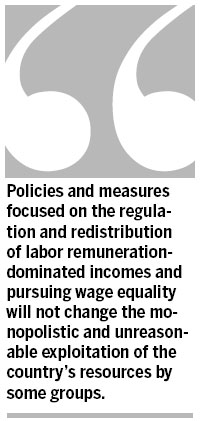
A fairer distribution of resources is needed, as policies and measures focused on the regulation and redistribution of labor remuneration-dominated incomes and pursuing wage equality will not change the monopolistic and unreasonable exploitation of the country's resources by some groups. Instead, they will undermine the interests of middle-income populations under the high-sounding excuse of income regulation.
A legal and standardized procedure should be introduced for the exploitation and utilization of the country's land and mineral resources in a bid to avoid administrative and power interventions. Practical regulations should also be introduced to forestall any infringements of farmers' interests in the ownership transfer of rural collective lands.
Besides, a set of strict ownership definition standards should be set up to prevent the flow of State-owned assets to certain groups and individuals in the process of economic re-organization. At the same time, an effective monitoring system should be put in place to restrict or eradicate the power of individual local leaders in resource redistribution.
To help regulate the income of high-income groups through taxation, the country should implement inheritance and property taxes as soon as possible. At the same time, measures should be taken to encourage employees to hold shares in the enterprises for which they work in order to narrow the income gaps caused by the uneven exploitation of assets.
In addition, the country should try to strengthen the trade union and wage negotiation system to help raise wages. At the same time, practical steps should be taken toward building an inclusive and balanced education system to uproot one of the key causes of the current income gaps.
Last but not least, the influence exerted by vested interest groups on the country's income distribution policies should be eradicated by promoting a democratic, fair and transparent decision-making mechanism for income distribution.
The author is director of the Institute of Population and Labor Economics under the Chinese Academy of Social Sciences.
(China Daily 04/12/2012 page8)
 New type of urbanization is in the details

Copyright 1995 - . All rights reserved. The content (including but not limited to text, photo, multimedia information, etc) published in this site belongs to China Daily Information Co (CDIC). Without written authorization from CDIC, such content shall not be republished or used in any form. Note: Browsers with 1024*768 or higher resolution are suggested for this site.
License for publishing multimedia online 0108263 Registration Number: 130349