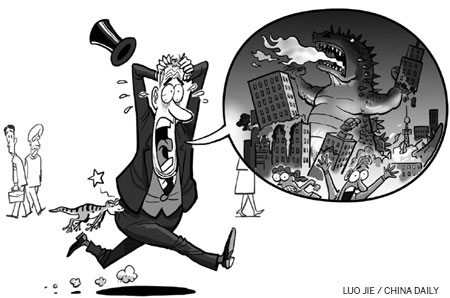
The current economic crisis is called the "global financial crisis". But is the term "global" really justified?
Yes, in much of the developed world - in Europe, North America and Russia - growth spluttered - and in many countries, but not in all years, rates of GDP growth turned negative. And yes, global output declined by 2 percent in 2009, but it also rebounded by 2.7 percent in 2010, and it is estimated to have risen by least as much in 2011.
The rebound of the global economy was actually dampened in the last two years because the crisis affected most developed parts of the world. These parts produce more goods and services than the other parts, so if their output goes down or stagnates, it tends to drag the global GDP down with it.
The global economic statistics we use show a tremendous Western, or rich world, bias. There is an implicit weighting scheme in the calculation that is seldom acknowledged. It is called "plutocratic" weighting, and it gives greater weight in the overall calculation to richer countries.
While the "plutocratic" growth rate gives an exact metric regarding what happens to overall economic output, a "people's", or population weighed, growth rate gives a more accurate idea as to how economic growth, or lack of it, affects individuals across the world.
So let's turn our attention to how the non-Western world has fared in the four years since the onset of this so-called global crisis: In sub-Saharan Africa, the average per capita real growth rate was 1.5 percent a year, in Latin America, it was nearly that high, and in Asia, it was 3 percent. These rates are impressive.
In the "people's" calculation, it is not the richest countries that matter the most, but the most populous. And it is precisely these populous countries that have continued to chalk up positive, and often very high, rates of growth in the midst of what is called "the worst crisis since the Great Depression."
Between 2007 and 2011, China's GDP per capita expanded by 43 percent, India's by 30 percent, Brazil's by 14 percent, and Indonesia's by 7 percent. These four countries are home to almost 3 billion people, or about 43 percent of the world population. Thus, it is not surprising that for the world as a whole, the average "people's" growth rate during the 2007-11 "crisis" was about 4 percent per capita, slightly above the 1990-2000 long-run average.
The reason why the Western media portray the crisis as a "global" crisis, and why, when non-crisis countries are mentioned at all, it is merely in their "supporting actor" role, is the same reason we rarely hear about the wars in Africa. People in the Western world, who are still much richer than others, are mostly interested in their own fortunes, and the fortunes of people similar to them, when they create and buy the news.
The Western media paid scant attention when Russia's GDP nosedived in the 1990s. A meaningless phrase, "transition recession", was created and used as if it were an explanation. The Asian crisis of 1998 attracted far more attention, chiefly because of the fears it might spread to developed market economies. But that threat never materialized, and the attention waned.
Meanwhile, two decades of unremitting African misery and descent into hell have passed largely unnoticed by the mainstream media. Nine African countries, with about 150 million people, have lower per capita incomes today than they did in 1980 - and seven of them lower than in 1960. In contrast infinitesimal movements in the stock markets are followed religiously.
What we have to contend with is an obvious bias. To a neutral " observer" a real income decline of 1 percent experienced by an African country should attract as much attention as 1 percent decline experienced by a similar-sized Western nation. Or should we care more about Bill Gates losing 1 percent of his income than a low-income laborer in Africa losing his job and thus all his income?
Rather than focusing only on total economic output as we do now, we ought to focus on how individuals' incomes across the world are affected. Thus, instead of giving each individual a weight according to his income, we should give the same weight to everybody. Such a statistical rebalancing would lead to a world where we move from caring about quantities to caring about people.
The author is an economist and author of The Haves and Have-Nots.
(China Daily 04/16/2012 page9)
 New type of urbanization is in the details

Copyright 1995 - . All rights reserved. The content (including but not limited to text, photo, multimedia information, etc) published in this site belongs to China Daily Information Co (CDIC). Without written authorization from CDIC, such content shall not be republished or used in any form. Note: Browsers with 1024*768 or higher resolution are suggested for this site.
License for publishing multimedia online 0108263 Registration Number: 130349