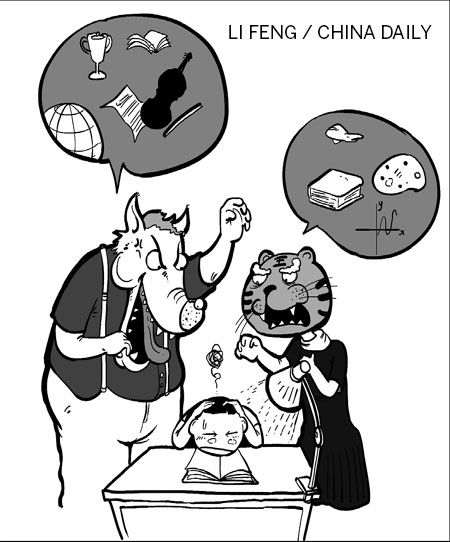
In the West, tiger mothers and wolf fathers are considered examples of extreme parenting. However, many Chinese parents put pressure on their children and probably look to such tiger mothers and wolf fathers as role models.
When I first came to China in 1985, it appeared to me that such pressure concerned only high school students who were going to enter universities. But in the following years, the phenomenon gradually encompassed first primary school children, then those of pre-school age, and finally newborn babies and pre-born children.
In the last two decades, the competition to do well in the national higher education entrance examination, or gaokao, has "infected" lower levels of school entrance, and even for access to a good kindergarten, children have to pass exams and interviews.
In order to succeed, one or two years before entering kindergarten they must study English, drawing, calligraphy, singing and dancing, and the three years of kindergarten are mostly spent to build up an early lead in primary school performance.
Noting the phenomenon, local educational authorities in cities such as Shanghai and Beijing have prohibited any kindergartens from imposing arbitrary charges for courses such as English and dancing, but such efforts are not so rewarding.
A recent survey by educational authorities in Shanghai shows that although more than 90 percent of kindergartens in the city do not set up related courses, and about three fourths of respondents disagree that their children will be less competitive than others after attending primary school if they do not get enough training in kindergarten, some 61 percent still sign up such courses for their children, and they seek it elsewhere if not from kindergartens.
What if parents let their 3 or 4-year-old child enjoy free time on Saturday and Sunday, after five days in nursery? They would be judged to be depriving their offspring of a chance in life. As others do, so must they do.
Yet children have not only the right, but the need to play.
Kindergartens, literally children's gardens, were originally intended to prepare children for primary school, showing them how to hold a pencil and other basic abilities and letting them socialize with other children, giving them a chance to play with others, to share, to make concessions, and to deal with misunderstandings and differences in opinion. This is particularly important in China where most children have no brothers and sisters and get used to being "little emperors" at home.
Kindergartens should not be a school. There should be no classroom, no lesson, no homework, and particularly no exam, which is strictly prohibited by the country's kindergarten operational guideline. Rather, play should be the prime activities for kindergarteners, who have an irrepressible drive to play.
They need to play with others and also to play on their own, as play facilitates not only creativity and imagination but also learning in a lively way. Children can discover numbers while playing games and the alphabet through songs. Some Chinese characters can become familiar to them by being used in games.
Although time and again the Chinese authorities have ordered that the amount of homework be reduced for students and encouraged parents to offer their children other educative paths, many parents judge such ideas a waste of time and they soon fill their children's free time with new competitive learning.
Such an unhealthy balance of work and play has terrible consequences for children's futures as it stifles their physical activities by making them sit still for long periods and deprives them of the time to socialize and thus they become introverted and asocial.
The problem is presently at its peak, because many Chinese parents stress academic performance above all. Children work hard while having less and less time to play. What these parents fail to realize is that they are actually following the examples of how not to raise a kid.
The author is a Canadian scholar living in China and the author of Work in Progress -Chinese education through a foreign expert's perspective.
(China Daily 04/19/2012 page9)
 New type of urbanization is in the details

Copyright 1995 - . All rights reserved. The content (including but not limited to text, photo, multimedia information, etc) published in this site belongs to China Daily Information Co (CDIC). Without written authorization from CDIC, such content shall not be republished or used in any form. Note: Browsers with 1024*768 or higher resolution are suggested for this site.
License for publishing multimedia online 0108263 Registration Number: 130349