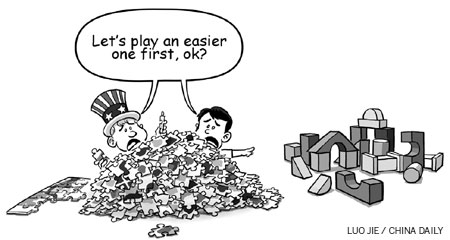
A visitor from another planet could be excused for walking away with the impression that acrimony and distrust reign supreme in the relations between the United States and China. Driven in no small part by the seemingly irresistible blood-sport of China bashing that dominates most foreign policy debates in the US campaign season, inflammatory rhetoric is accentuating the differences between the two nations and preventing sane voices that focus on the common interests and tangible opportunities for international cooperation from being heard. The rabble-rousing crescendo invokes Cato the Elder and his inability to end a speech without calling for the destruction of Carthage.
The current climate raises specters of the Cold War and its doctrine of mutual assured destruction - a doctrine aptly known by its acronym "MAD". But despite the unpleasant shrillness of headline-seeking polemics that accompany the build up to the presidential election in the US, it is actually the absence of meaningful dialogue that bears far more damaging potential - the silence is deafening.
Both China and the US are faced with significant trials and tribulations on the home front as well as in the global setting. The repercussions of events in remote locations can be felt acutely at home, and economic challenges are by no means the only ones that are swept in by the tides of globalization. All the simplistic clichs and platitudes regarding the quest for regional or global supremacy - again, a Cold War relic that should have been buried alongside the Cold War itself - are drowning the voices of reason that state what should be obvious to all: that in a world with bankrupt countries that run their state budgets like giant Ponzi schemes, in a world with ever-growing and rapidly ageing populations clamoring for finite resources, in a world suffering the unpredictable consequences of climate change - in short, a world beset by natural and manmade disasters, the US and China can ill-afford to accentuate all that divides them. It is patently absurd to expect any progress in containing threats such as nuclear proliferation, military-technological sabotage, or significant breaches of cyber security, all of which have manifestly global implications, unless the two countries can overcome their lingering distrust and political or cultural differences, and instead focus on the many important areas where their interests are aligned, rather than opposed.
But for that alignment to happen, real dialogue has to take place. We cannot take a timeout from talking, even if these are delicate times of transition for both countries. There needs to be real talking, not the overly formal and scripted interaction that takes place during state visits or in diplomatic communiqus. Real talking takes place when real people with real responsibilities sit down, roll up their sleeves, and get to work. This needs to happen at the economic and commercial level, and it needs to happen at the military level. It needs to happen between professional experts, and it needs to happen between government officials. It needs to happen between the current generation of leaders, and it needs to happen between future leaders and stakeholders. Because in the absence of real talking, each side demonizes the other and conspiracy theories take on a life of their own and threaten to become self-fulfilling prophecies.
To facilitate real dialogue between them, China and the US should adopt a "two-list" approach. One list - we can call it the dark list - would contain all the areas where one country's national standpoint is diametrically and competitively opposed to the standpoint of the other, and the interests of the two countries cannot be aligned, at least not without major political sacrifices. Interestingly, and hardly coincidentally, the more the actual interests of the two countries resemble one another within their respective orbits, the more they will be perceived by both sides as irreconcilable. This dark list should be kept in a drawer, to be consulted periodically for the sole purpose of examining whether one of its items might be ready to be moved to the other list.
The other list - we can call it the bright list -would contain all the areas where the interests of the two countries are aligned, or where they can be aligned if discussed in good faith. It should go without saying that our goal here is to keep the dark list short and the bright list long. And it should be equally obvious that the more we talk to each other - real talk, far away from cameras and microphones - the more dominant the bright list and the more inconsequential the dark list become.
It is our great challenge to neutralize the voices that only chatter - actually, scream - about the dark list. We have gotten so accustomed to viewing important issues through the prism of negativity, that we are losing the ability to engage in rational, constructive dialogue and base our positions on even-handed arguments and empirical evidence. We should be able to discuss issues that are critical to both countries calmly and sensibly, rather than automatically placing them on the dark list. No matter how insistent some voices call for geopolitical hegemony, nations will have to behave intelligently and harmoniously if they wish to prosper under the yoke of diminishing resources and momentous common threats.
If we sat down and tried to resolve our issues within the win-win proposition of the bright list, then we would realize that politics and ideology lead to dangerous oversimplifications and blatantly ignore the intricate fabric of the two countries' intertwined interests. But once the cantankerous genie is out of the bottle, it becomes well-neigh impossible to put it back.
It is indeed high time for a two-list approach. And if we focus our energy on the bright list, we will replace silence with dialogue, and confrontation with harmony.
The author is a member of the Board of the Liechtenstein Foundation for State Governance.
(China Daily 04/24/2012 page9)
 New type of urbanization is in the details

Copyright 1995 - . All rights reserved. The content (including but not limited to text, photo, multimedia information, etc) published in this site belongs to China Daily Information Co (CDIC). Without written authorization from CDIC, such content shall not be republished or used in any form. Note: Browsers with 1024*768 or higher resolution are suggested for this site.
License for publishing multimedia online 0108263 Registration Number: 130349