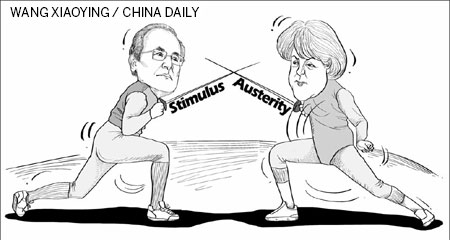
For better or worse, Europe is now engaged in an insurrection against the fiscal pact condemning European Union member countries to austerity without growth. Will the election of Francois Hollande as French president change Germany's up to now uncompromising stance?
The prospect of reducing public deficits to less than 3 percent of GDP is unrealistic in both the Netherlands and Spain. Unless it is ready to take punitive measures now, the EU will have to give these countries additional leeway, mindful that the European public tends to respond negatively every time it is consulted. In Greece, the recent election has not yielded a majority coalition capable of taking ownership of the austerity plan, making yet another popular vote likely.
Ireland, fortunately, is less worrying, but the odds on the fiscal pact being approved in a popular referendum are becoming longer. Granted, the removal of the unanimity clause provides a way to avoid this obstacle and allow for the pact's implementation. But this solves nothing, because neither France nor Italy will ratify the pact. Even Germany's Social Democrats, whose support Chancellor Angela Merkel needs to secure ratification in the Bundestag, appear to have granted only conditional support.
Germany is accused of monetarist dogmatism and of being responsible for accentuating the economic asymmetry between it and its eurozone neighbors. Its relatively good economic health allows it to finance its debt at less than the rate of inflation, while other European states finance theirs at rates that are three points higher than inflation.
With Hollande's defeat of Nicolas Sarkozy, Merkel has virtually no support in the eurozone besides that of Finland. The support of Sarkozy was very useful to the Germans in advancing their views, while Sarkozy accepted his role in order to maintain France's key role in Europe's crisis management. Thus traditionally pro-federalist Germany aligned with France's longstanding insistence on a Europe of governments. But, in terms of substance, austerity versus urgently needed economic growth, France lost.
Hollande is determined to change course. He believes deeply in the centrality to Europe of the Franco-German relationship. Yet he is enough of a realist to see that the relationship is significantly unbalanced, owing to France's economic decline, and that Sarkozy's endorsement of German preferences was not worth the appearance of being at the heart of the decision.
Hollande's victory has already sharply redefined European politics. Almost all European governments are counting on him to change the balance of power. Rarely has a French election had such repercussions in Europe. Will he succeed?
The four proposals that Hollande has put forward are so consensual that it will be difficult for Germany to oppose them: use of non-disbursed resources from the EU Structural Funds, recapitalization of the European Investment Bank, creation of project bonds, and taxation of financial transactions. Significantly, the two proposals that were most likely to meet German opposition, Eurobonds to pool risk and the transformation of the European Stability Mechanism into a bank that could borrow from the European Central Bank, were removed from his draft memorandum to European leaders.
Despite the gravity of the situation, Hollande has three advantages: excessive austerity is unrealistic given growing social opposition; public deficits are only a small part of Europe's problems, and are not necessarily the source of the crisis; and a strong consensus has emerged outside of Germany to change tack. Moreover, during the G8 summit, Hollande enjoyed the support of the United States, which worries that deflation in Europe would slow its own economic recovery.
Germany has historically never benefited from isolation. It is probably on the basis of this historical-political argument that Hollande will be able to bring about a shift in the German position.
Of course, one might argue that the emerging European consensus is quite ambiguous. Some favor stimulating growth through investment projects, while others emphasize structural reform. Furthermore, there is no guarantee that Hollande's proposals will quickly revive moribund economies. Indeed, it is blatantly obvious that in a country like France, reducing public spending, especially the state's often-unproductive operating expenditures, is a prerequisite for recovery.
Yet Europe's problems, by definition, cannot be solved simultaneously. And what is not at all ambiguous is the public's rejection of austerity, or, for that matter, financial markets' increasing concern that long-term growth could suffer. That is a rare and powerful alliance, and one that Europe's political leaders ignore at their peril.
The author is professor of International Relations at Institut d'tudes politiques de Paris (Sciences-Po).
Project Syndicate
(China Daily 05/24/2012 page9)


Copyright 1995 - . All rights reserved. The content (including but not limited to text, photo, multimedia information, etc) published in this site belongs to China Daily Information Co (CDIC). Without written authorization from CDIC, such content shall not be republished or used in any form. Note: Browsers with 1024*768 or higher resolution are suggested for this site.
License for publishing multimedia online 0108263 Registration Number: 130349