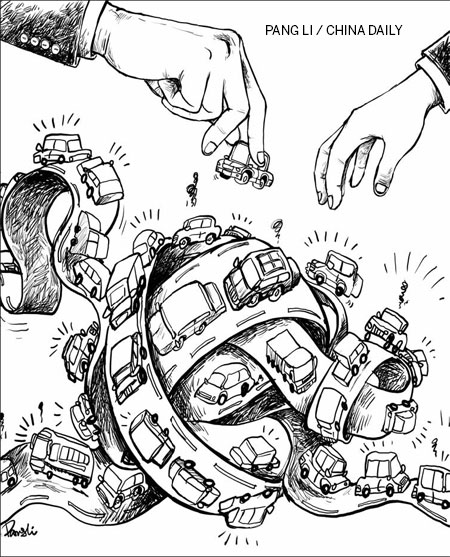
We can't live with them, and despite the government's best efforts, it seems we can't stop them multiplying. Why do people in cities continue to buy cars, when in all likelihood it just means being stuck in traffic, breathing exhaust fumes, while their blood pressure rises.
On July 1, following the example of Beijing and Shanghai, which have already introduced measures to limit the number of cars on the streets, Guangzhou implemented measures to restrict the growing number of cars in the city.
Beijing introduced restrictions on car use in 2007. Each car can only be used four out of five workdays per week, according to their license plate number. In theory, 20 percent of cars are off the road every weekday.
While Beijing's is a restriction on use, Guangzhou and Shanghai have chosen to restrict car ownership. Guangzhou has introduced a quota of 10,000 cars per month, less than half the 25,000 per month of the last few years. Shanghai, following Singapore's example, restricts car use by auctioning license plates.
The practice in Shanghai has been less controversial since it is closer to a market-based system in which people with the ability and willingness to pay still can buy a car. A quota system leaves people feeling that they have no control over their consumer decisions or how to spend their money.
A system that allows more people to own cars but pay more for the use of them may be a useful supplement to the car quota system. This is the case in London and Singapore, which introduced road-pricing systems, where people pay to enter and use certain roads. In effect an invisible hand that diverts and directs traffic.
While such policies will be effective in the short term, in the long run a city's transport policies need to be considered holistically.
The limits on cars will only work if the demand for transport can be met effectively by public transport. Given an alternative that is cheaper, faster and more environmentally friendly, pragmatic commuters would give up their cars.
Even if the price of cars goes up, or a quota is set, the transport needs of residents need to be met. A cap on demand is only half the equation. The other needs to be large and continued investments in public transport such as trains and buses.
Today, subways in Guangzhou serve 5 million people daily. But six out of the eight subway lines are already running at full capacity. Adding further capacity will be both costly and time consuming.
However, buses are a different matter, cheaper, more flexible and already relatively well established in Guangzhou. There are already more than 350 bus routes and over 7,000 buses. The rapid bus transit system in Guangzhou is one of the busiest in the world.
Unlike many other Chinese cities that have one dominant State-owned bus company, Guangzhou has three large corporate groups operating the bus services. Thus it already has in place a regulatory environment that expects private sector participation, and a culture that is attuned to expectations of good service.
There should be more liberalization and a push to get people out of their cars and into buses.
The policies introduced by Beijing and Guangzhou are aimed at reducing the number of car owners by rationing. The government does not raise any revenue from this sort of policy. This is different from Shanghai, where the municipal government raises revenue by selling licenses, using the money raised to improve public transport. This is essentially a way to redistribute wealth from car owners to people using public transport. A similar logic operates in Moscow where the government raises revenue by charging car park fees and then uses the money for public transport.
Changing public behavior is always a difficult task. This is especially true when it comes to driving. However, given the competition for land use, climate degradation and the rising quality of public transport, policymakers now have a better opportunity to reduce cars use, at least in cities.
Qian Jiwei is a research associate at the East Asian Institute and Leong Ching a researcher at the Lee Kuan Yew School of Public Policy, both at the National University of Singapore.
(China Daily 07/12/2012 page9)


Copyright 1995 - . All rights reserved. The content (including but not limited to text, photo, multimedia information, etc) published in this site belongs to China Daily Information Co (CDIC). Without written authorization from CDIC, such content shall not be republished or used in any form. Note: Browsers with 1024*768 or higher resolution are suggested for this site.
License for publishing multimedia online 0108263 Registration Number: 130349