Dispelling speculation that he might be removed from his post because of his outspoken opposition to Shintaro Ishihara's farce of "purchasing" the Diaoyu Islands, Japanese Ambassador to China Uichiro Niwa returned to Beijing on Monday, following his trip to Tokyo on Sunday to report on the current state of Sino-Japanese relations.
His trip shows the parlous state of the relationship since the troublemaking right-wing Tokyo governor announced his proposal to "purchase" the Diaoyu Islands in April.
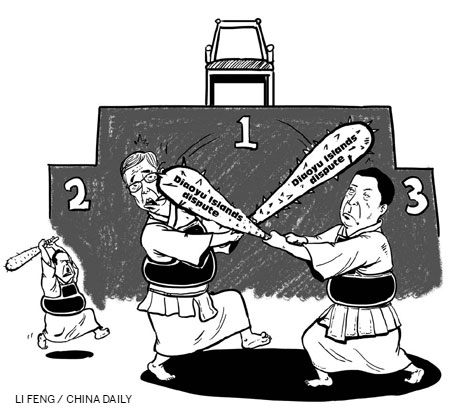
Unfortunately, Japan's domestic woes mean Ishihara's ridiculous scheme of transferring the "ownership" of the islands has picked up a head of steam. The Japanese government has conveyed its intention of "nationalizing" the main Diaoyu Island and two affiliated islands and claims it has already begun negotiations with the "private owners". Japanese Prime Minister Yoshihiko Noda said on July 10 that the "nationalization" of the Diaoyu Islands could take place as early as September.
The real intention behind Ishihara's proposal to "buy" the islands is to put pressure on the ruling Democratic Party of Japan. He hopes the government's handling of the issue will make it lose public support and pave the way for the rise of the right wing and his own path to power.
It is out of domestic political need that the Noda cabinet announced the plan to "nationalize" the uninhabited islands. His ruling Democratic Party of Japan has to rely on the Liberal Democratic Party and New Clean Government Party to stay in power. The Noda administration is clutching at straws to divert public attention from domestic problems.
The government could easily have ignored Ishihara's grandstanding, as according to its security policy, local governments have no right to meddle with issues involving national security. However, the weak central government does not dare oppose Ishihara because it fears that it will lose public support if it is accused of not standing up to China.
By pushing for a change in "ownership" of the Diaoyu Islands the Japanese government is also hoping to take effective control over the islands and create a "legal" case for its claim to the territory. It believes that "nationalizing" the uninhabited islands will provide the "legal" grounds to win international recognition of its possession of the Diaoyu Islands in the event of any potential international arbitration in the future.
The realization of its plan to transfer the land "ownership" of the three islands would enable the Japanese government to argue a legal case of actual jurisdiction and possession over the Diaoyu Islands if it took the dispute to the International Court of Justice or the International Tribunal for the Law of the Sea for adjudication.
If China takes strong reactions, it is possible that the Japanese government would then send garrison to the islands. If so, military force would be the only choice for China. Certainly, if China opts to use military force to solve the dispute, any attempt by Japan to create a legal case would be in vain.
Japan's attempts to change the status quo are also closely related to the United States' strategic pivot to Asia, which has the key objective of containing China. Since Japan leans heavily on the support of the US, it will continue to try and strengthen its actual and legal control over the Diaoyu Islands to assist the US in containing China.
After Hillary Clinton stressed twice in 2010 that the US had the obligation to defend the Diaoyu Islands according to the Treaty of Mutual Cooperation and Security between Japan and the US, Japan has become bolder in its provocations over the islands.
However, the Cairo Declaration of 1943 and the Potsdam Proclamation of 1945, which defined the terms for the Japanese surrender at the end of World War II, stipulated that Japan should return all the territory it had seized from China during and after the 1894-95 war, including Taiwan and the Penghu Islands. As the Diaoyu Islands belong to Taiwan's Yilan county, they should have automatically been returned to China. But after the Japanese surrender the Diaoyu Islands were still under the jurisdiction of the US army in Okinawa. When the US handed over Okinawa to Japan on May 15, 1972, it also transferred the administration rights of the Diaoyu Islands to Japan.
But this does not alter the fact that the sovereignty of the Diaoyu Islands legally belongs to China, and therefore a bilateral treaty between Japan and the US does not cover them.
Applying the US-Japan Treaty of Mutual Cooperation and Security to the Diaoyu Islands is illegal and invalid. It is a deliberate distortion of international law and runs counter to the principles of international law.
In fact, the attitude of the US Secretary of State Hillary Clinton toward the Diaoyu Islands has changed since 2010, and she has since expressed concerns about Japan's plan to "nationalize" the islands.
Therefore, the Chinese government should actively try and persuade the US to encourage Japan to return the islands to China, their real owner.
Meanwhile, the Noda cabinet should stop the farce of "nationalizing" the islands, it should be aware that China will take the appropriate and necessary countermeasures to protect its sovereignty and interests.
The author is a professor at the Institute of International Relations, China Foreign Affairs University.
(China Daily 07/17/2012 page9)


Copyright 1995 - . All rights reserved. The content (including but not limited to text, photo, multimedia information, etc) published in this site belongs to China Daily Information Co (CDIC). Without written authorization from CDIC, such content shall not be republished or used in any form. Note: Browsers with 1024*768 or higher resolution are suggested for this site.
License for publishing multimedia online 0108263 Registration Number: 130349