China issued a white paper on the Diaoyu Islands on Tuesday so that the international community would better understand Beijing's stance on the Diaoyu Islands dispute. This is especially important because of the United Nations General Assembly session underway in New York.
The "nationalization" of the Diaoyu Islands by Japan is not only an infringement of China's sovereignty and territorial integrity, but also a severe challenge to the post-World War II international order. The Cairo Declaration of 1943 and Potsdam Proclamation of 1945 required Japan to return Taiwan and its affiliated Diaoyu Islands to China, which is part of the international order.
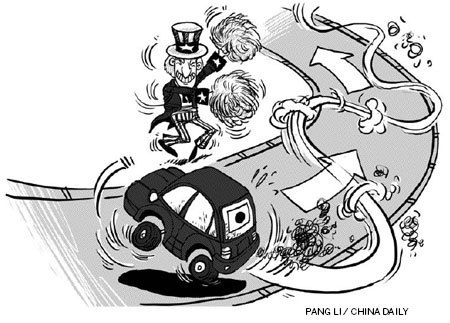
The international community, especially the United States, made great efforts to build the post-World War II international order. So Washington has to be aware of the serious consequences Tokyo's provocations could cause. The US should not forget the aggressive past of Japan, especially the attacks on Pearl Harbor in 1941, which partly was the result of Washington's tolerance of Japanese expansionism.
Unfortunately, the contradictory statements of US Secretary of Defense Leon Panetta during his visit to Japan and China last week proves the fact that Washington is using the China-Japan dispute to strengthen its military presence in the Asian-Pacific region. On one hand, Panetta said the US would not take sides in the Diaoyu Islands dispute, on the other hand, he declared that US-Japan security treaty covers the Diaoyu Islands.
The US wants to play the role of a "mediator". However, a mediator should be impartial, which Washington is not. Nor does it want to help resolve any dispute. Moreover, the US-Japan alliance disqualifies Washington from being even a "communicator" in the Diaoyu Islands dispute.
Nobody expected Panetta's visit to Asia to break the impasse, because the US wants to use Japan and the Sino-Japanese dispute to contain China's rise so that it can maintain its supremacy in Asia-Pacific. But at the same time, Washington doesn't want the situation to go out of control, because that could draw it into direct confrontation with China.
Against this backdrop and as part of its "pivot to Asia" strategy, the US has taken a series of steps in the Asia-Pacific region, including the deployment of the Osprey aircraft in Okinawa, Japan.
Japan is trying to get a free ride on America's "pivot to Asia" strategy now that the balance of power between China and the US is changing and Washington needs Tokyo to guard against Beijing. So to "deal" with China, Japan will not shy away from making full use of the US.
Considering Japan's motive and purpose, US policymakers need to tread with caution and rethink their commitment to Japan, if they have any, so that America is not drawn into an unnecessary conflict. This is why Panetta warned the Japanese government not to take radical actions.
Electoral factors, too, have prompted Japan to intensify its disputes over islands with Russia, the Republic of Korea and China. But Japan should not be swayed by its electoral politics, for a seasoned politician has to see beyond domestic public opinion. It is easy to arouse national sentiments but much more difficult to cool them down. In case nationalism gains the upper hand in Japan, other policy options will get a not so glorious burial, which would not be a welcome situation, because it could lead to conflicts with other countries in the region.
China's influence is increasing in the Asia-Pacific region and even the rest of the world, while the US' is declining. This is a relatively long-term but inevitable trend, which the US finds very uncomfortable to accept. The change in the balance of power will gradually erode the supremacy of the US and other countries' confidence in America's might. This realization seems to be giving American politicians and policymakers sleepless nights.
Given China's increasing diplomatic influence in East Asia, the US will make every effort to maintain its influence in the region. That's why it is using the territorial sea disputes between China and some of its neighbors to display its diplomatic "smart power".
The US is taking some short-term measures to create an unfavorable situation for China to thwart its peaceful rise. What Washington has done after announcing its "pivot to Asia" strategy is in line with this logic.
The Diaoyu Islands dispute has intensified to such an extent that it could lead to more frequent frictions and even a military conflict, which is something China does not want.
For China, an overly tough, inelastic policy or an overly mild policy both will lead to problems. In the long run, Beijing's foreign policy should be a well-balanced combination of both mild and tough policies. China should judge a situation on the basis of reality and the reactions of other countries.
Had Japan been rational, it would have realized that it is unwise to infringe on the interests of a rising neighboring power, even with the backing of the US, for once a conflict breaks out, Washington will be more than happy to stand by and see Tokyo pay a heavy price.
Over the past several decades, China has been pursuing a foreign policy of "win-win" cooperation.
But the results of such a policy depend on whether the other side is equally willing to do so. If the other side pursues an agenda of winner-takes-all or is opportunistic, China's unilateral goodwill will not yield any results. Instead, it will make it easier for the other side to take more provocative actions and encourage other countries to do the same.
The author is associate research fellow at the National Institute of International Strategy, China Academy of Social Sciences.
(China Daily 09/27/2012 page9)
 New type of urbanization is in the details

Copyright 1995 - . All rights reserved. The content (including but not limited to text, photo, multimedia information, etc) published in this site belongs to China Daily Information Co (CDIC). Without written authorization from CDIC, such content shall not be republished or used in any form. Note: Browsers with 1024*768 or higher resolution are suggested for this site.
License for publishing multimedia online 0108263 Registration Number: 130349