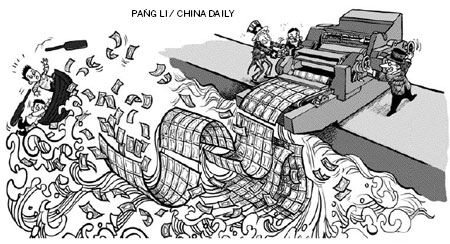
Recently, the central banks of three of the world's largest economies attempted to stimulate their economies by adding new liquidities. The US Federal Reserve under chairman Ben Bernanke, acting on its promise to address the worst US unemployment since the Great Depression, decided to purchase mortgage-backed securities worth up to $40 billion every month.
The program will be executed indefinitely until the unemployment falls to a more acceptable level. This is known as QE3, following two similar monetary stimulus initiatives since the global financial crisis struck. This decision was made only a few days after European Central Bank President Mario Draghi announced his version of monetary easing, or what he called outright monetary transactions (OMT). It took the form of a program to purchase sovereign bonds of eurozone countries in the secondary market with fewer conditions.
There is now no requirement for triple A-rated bank collateral, and the bonds are not treated as senior loan, meaning in the event of bankruptcy, the ECB loan does not get priority for repayment. However, countries have to subscribe to a bailout program with tough fiscal and structural reform conditions - as in the case of Greece, Ireland and Portugal.
After this, the Bank of Japan too implemented its brand of quantitative easing by buying assets held by banks and giving them loans of about $4,127 billion. On Oct 26, Japan's Cabinet approved a 423 billion yen ($5.3 billion) economic stimulus package, a move to combat recession as its economic recovery falters.
In all these policies, the central banks seem to show the public that they are proactively pursuing a policy to salvage their economies. In a way, these independent central banks have made a unilateral decision to make the policies, without being pressured by their governments.
There is no clear answer as to whether these policies work. Most economists who support QE3 could only claim that it is because of these actions that the countries' financial sectors, as well as the global financial system have not worsened. Indeed, every time such a policy has been announced, the market has responded positively, though only for a short time before doubts returned. Only market players seem to welcome the moves of these monetary authorities and even then such positive response has lasted only briefly.
After the initial euphoria, the market players resume worrying about the longer-term problems, like whether the sovereigns could repay their debts, when growth would resume and when the unemployment problem would dissipate. In other words, there is skepticism over the long-term impact of these monetary policies and whether they are effective to address the problem of unemployment.
Draghi has stated very clearly that OMT cannot be effective without cooperation from the real sector. Monetary policy alone is not enough to have an impact on the real sector. Basically, monetary policy is no substitute for fiscal policy. The problem lies in weak demand coupled with a fragile financial system. There is also the issue of whether a monetary authority has a clear mandate to address the problem of unemployment that a quantitative easing is clearly meant to tackle. In a way a quantitative easing seems to be a quasi-fiscal policy, which may not be within the mandate of a central bank.
For sure the Federal Reserve's mandate does include the objective of achieving full employment in the US. However, this is not clearly the case with the ECB, whose main function is to maintain stability against inflation and deflation. Most central banks in Asia after the Asian financial crisis of 1997-98 have also become independent with a narrower mandate of merely guarding financial and/or economic stability.
Another issue involves the ballooning of the balance sheet of these central banks and its implication. In the last four years of QE1 and QE2, the balance sheet of the Fed increased by more than $2 trillion. Now there is a serious possibility of a sovereign default by Greece because of euro crisis. And if ECB loans to banks are not treated as senior loans, there is a grave possibility of a central bank default.
A more serious impact many economists are worried about is on price stability or inflation. It does not take a hardcore monetarist to believe that too much liquidity would ultimately result in inflationary pressure. The Japanese economy in the 1980s and the US economy in the 1990s showed that too much liquidity and very low interest rates for too long could create bubbles - properties or stocks which ultimately developed into financial crises.
The worry over the impact of this strategy on inflationary pressure is as valid as concerns over the quantitative easing executed by the Fed, the ECB and the BOJ.
For emerging Asian economies, there is yet another concern that cannot be ignored. Money is "fungible", as students of monetary economics would say. Additional liquidities arising from the QE3 initiatives of these central banks will not necessarily be spent in their own economies. Any extra liquidity that households, enterprises or banks have will be used first to clear their outstanding obligations and to improve their balance sheets (deleveraging) before any though about spending, which would then create additional demand, boosting growth and ultimately employment.
But where will these additional funds go? They will flow to where there is more room for profit. In this regard, the emerging economies are the most likely destination. In a globalized financial system, it is the emerging economies that will have to deal with these additional liquidities looking for room to unload. This means additional challenge for the monetary authorities of the emerging Asian economies, which are already facing increasing risks in general.
The author is a professor in the international political economy programme, Nanyang Technological University. He is former governor of Bank Indonesia, the Indonesian central bank.
(China Daily 10/29/2012 page9)
 New type of urbanization is in the details

Copyright 1995 - . All rights reserved. The content (including but not limited to text, photo, multimedia information, etc) published in this site belongs to China Daily Information Co (CDIC). Without written authorization from CDIC, such content shall not be republished or used in any form. Note: Browsers with 1024*768 or higher resolution are suggested for this site.
License for publishing multimedia online 0108263 Registration Number: 130349