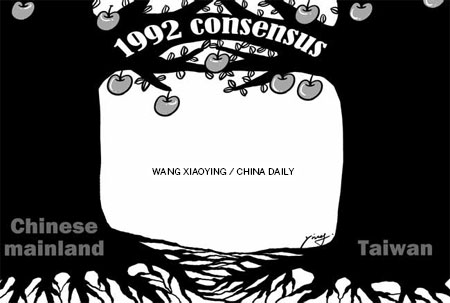
Dec 3, 2012, marks the 20th anniversary of the 1992 Consensus for cross-Straits relations. The past four years, during which the Economic Cooperation Framework Agreement and other economic, social, cultural and communication links were established, have seen the 1992 Consensus create "the most peaceful state of cross-Straits relations in 60 years", according to Taiwan leader Ma Ying-jeou.
Thus, on Jan 14, 2012, it was the people's acceptance of the 1992 Consensus that saw Ma being elected to a second term as Taiwan leader. At the same time, it was the rejection of the 1992 Consensus by the pro-independence candidate, Tsai Ing-wen, which led to her defeat. The verdict is clear: in cross-Straits matters, Taiwan people fully expect their leaders to carry out what the 1992 Consensus truly says and requires. This must be done with sincerity, mutual trust and urgency.
It is clear that the 1992 Consensus, with full support from the Chinese mainland, became the secure foundation for cross-Straits successes of the past four years. It is also clear that the 1992 Consensus will be the proven foundation for future peaceful cross-Straits relations. Thus the 1992 Consensus is more than a key cross-Straits document. In its application, it has become the effective guiding light for establishing tangible cross-Straits relations. It patiently guides and urgently implores both sides for cross-Straits unity.
The sense of urgency is apparent. Immediately after the leadership transition at the 18th National Congress of the Communist Party of China earlier this month, Kuomintang chairman Ma Ying-jeou sent congratulatory messages both to former CPC general secretary Hu Jintao and his successor Xi Jinping. Ma confirmed the key role the 1992 Consensus has played in the past and will play in the future. For cross-Straits expansion and deepening of exchanges, Ma singled out "mutual trust" and "sincere cooperation" as key factors. As concrete steps, he suggested setting up relevant organization offices on both sides of the Straits.
The replies of Hu Jintao and Xi Jinping to Ma also came immediately. Hu said the significant achievements of the past would enable CPC and KMT to continue, enhance and deepen the peaceful development of cross-Straits relations in order to benefit compatriots and rejuvenate the Chinese nation.
Xi, in his reply, hoped the CPC and KMT would seize the "historical opportunity" to deepen mutual trust, and consolidate and advance the peaceful cross-Straits ties in foundational matters that are political, economic, cultural and social.
To fully appreciate the significance of the 1992 Consensus during its 20th anniversary and in light of the 2012 leadership transition on both sides of the Straits, we may do well to review what the 1992 Consensus truly says and requires.
Ostensibly, the 1992 Consensus states plainly and simply that, while each side of the Straits can hold its own interpretation of "one-China", the "one-China" concept itself is invariant.
There are two parts to this statement: de facto and de jure. The de facto part states what in fact the case is: that each side of the Straits holds its own interpretation of "one-China". The de jure part states what ought to be the case: the invariant "one-China".
The 1992 Consensus is not static; its two parts are in constant dynamic interaction. The de facto part seeks guidance from the de jure part, even as the de jure part, drawing from history and culture, urgently implores members of the de facto part to move forward toward unity. This is not the unity of sameness. This is the unity with Chinese characteristics: unity achieved by preserving divergence in dynamic harmony.
Such interactions are historically and culturally incumbent on both sides of the Straits. This is because of the ancient political-cultural ideal known as the "Great Unification" (Dayitong), which roughly says the essential diversity of China during any of its historical periods must ultimately come under harmonious unification achieved politically, economically, socially and culturally.
In early Chinese history, the "Great Unification" ideal - traceable to Confucius, Mencius and other philosophers - was systematized by the great Han philosopher Dong Zhongshu (179- 104 BC) in his magnum opus, Chunquifanlu. Dong's "Great Unification", periodically reinterpreted, became culturally dominant throughout Chinese history. Every Chinese historical period has either maintained or returned to the "Great Unification". China today is in the returning phase. One can say that the urge for "Great Unification" has been part and parcel of China's cultural DNA throughout its long history.
The 1992 Consensus would be the modern articulation of the "Great Unification" ideal. The oft-mentioned "historical opportunity" awaiting the CPC and KMT is the opportunity for both sides of the Straits to return to rightful unity as a nation and culture.
At this juncture, the cross-Straits journey toward the "Great Unification" is only half-traveled. This is the half that includes matters economic, social and cultural. The half that has not been traveled includes security and political matters.
In his report to the 18th CPC Congress, Hu suggests that, under the special situation of not yet being unified, the two sides of the Straits may explore the possibility of political relations, security, mutual trust and cross-Straits peace agreement. In his reply to Ma, Xi mentioned political foundation as being important for cross-Straits ties.
Ma has been most enthusiastic about the first half of the journey already traveled. Given his emphasis on "mutual trust" and "sincere cooperation" and his recent display of urgency by reaching out to Hu and Xi, he should be equally enthusiastic about the second half, a journey involving matters political and security, and a peace agreement. There are worries, however, about his focus. Sometimes, he is distracted by domestic and international politics.
Given the 1992 Consensus, history, the cultural "Great Unification", wise leadership and the support of people on both sides of the Straits, the cross-Straits journey of unification will be completed, sooner or later. This is a sure thing.
The author teaches philosophy at Montclair State University, US.
(China Daily 11/28/2012 page9)
 New type of urbanization is in the details

Copyright 1995 - . All rights reserved. The content (including but not limited to text, photo, multimedia information, etc) published in this site belongs to China Daily Information Co (CDIC). Without written authorization from CDIC, such content shall not be republished or used in any form. Note: Browsers with 1024*768 or higher resolution are suggested for this site.
License for publishing multimedia online 0108263 Registration Number: 130349