Online use, not abuse
It is a consensus that people's freedom of speech should have legal and political boundaries to prevent wrongdoing
In its World Report 2013 published on Friday, Human Rights Watch, an international non-governmental organization on human rights research and advocacy headquartered in New York, continues lashing out at China, saying "its human rights record remained poor in 2012, with minimal significant progress on political, civil, socio-economic or cultural rights".
"When challenged by its citizens, repression or tactical retreat rather than systemic reform remains the Chinese government's default response," the report claimed, citing some fictional cases to denounce the Chinese government's "violation of internal and international laws". However, it also admitted that the amendments to the Criminal Procedure Law in March and the amendments to the Mental Health Law in October "were improved in key aspects as a result of intensive civil society efforts".
While accusing China of monitoring the media, the report also said that more than 300 million Chinese Internet users can express their views and discontent via Sina Weibo, China's largest micro-blogging website. Despite suffering different limits, Chinese citizens are increasingly vocal, especially online, in some cases forcing the government to make concessions or even to take their demands into account, as the report puts it.
The use of such contradictory words about China is explicit evidence that China holds a consistently supportive and open attitude toward its citizens' freedom of speech. At a time when legislation has been widely adopted across the world to impose moderate legal curbs on Web opinions, it is groundless to criticize the Chinese government for its bid to protect its citizens' freedom of speech through legal means. This is just a condescending rebuke of China by those self-proclaimed moral judges in the West and a political attempt to defame Beijing.
China has made tangible efforts to guarantee the freedom of speech for its citizens in recent years. In its National Human Rights Action Plan launched in June, the Chinese government made explicit commitments to "guarantee citizens' freedom of speech and their right of expression". At the same time, some concrete systematic arrangements and guarantee measures were drafted for the implementation of the plan. In particular, the plan confirmed that news organizations and practitioners should have access to information and enjoy their legitimate rights for interviews, publication, criticism and supervision.
With the booming development of the Internet in recent years, China now has the world's largest population of netizens. They can not only express their independent viewpoints on State affairs, they can also exercise a supervisory role and even report clues of malfeasance. In fact, it has become common practice for Chinese people to exercise their right to freedom of speech online, as indicated by netizens' exposure of a series of recent corruption cases and infringements of people's rights by government officials and their settlement in a timely manner.
"Man is born free, and everywhere he is in chains," as French thinker Jean-Jacques Rousseau put it. It is a consensus that people's freedom of speech should be given legal and political boundaries. The political correctness that enjoys a tacit consent among the Western public is also a restraint on the expression of public opinion.
Ruling on the Gitlow v. New York case in 1925, the United States' Supreme Court made it clear that in the US freedom of speech and freedom of the press are guaranteed by the country's constitution. However, this does not mean a person is immune from punishment if they irresponsibly express their views. The ruling is tantamount to the legal principle that people are free to speak, but they are not fully free to act based on their remarks. Such a principle has not only laid the basic legal basis for the courts to handle cases related to freedom of speech and freedom of the press, it has also evolved into a universally recognized legal principle for the rest of the world.
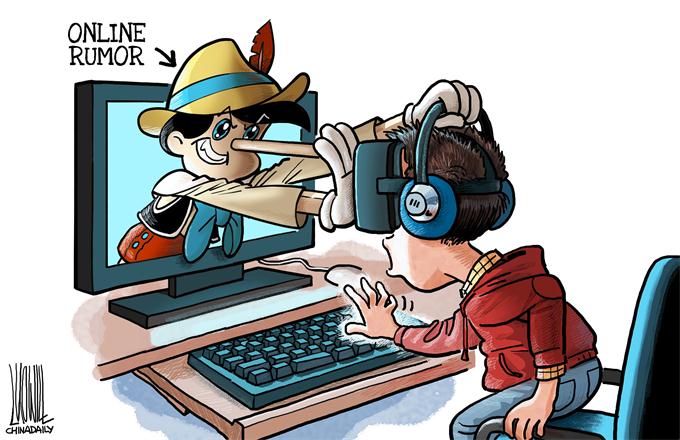
Despite the Internet's burgeoning development in recent years, the increasing libel, fraud, defamation, identity theft and leaking of personal information have caused ever-growing concern and repulsion among the public. At the end of 2012, extensive debates were launched throughout various social circles in China about the Internet and freedom of speech. Afterward, a wide consensus was reached among netizens and the public that certain legal restrictions should be put on the Internet to create a clean environment for the expression of online views. In this context, China's top legislative body passed a regulation on Dec 28, 2012, requiring Internet users register for Internet services using their real names and online service providers enforce real-name registration.
The creation of such regulations based on extensive discussions with the participation of the whole of society demonstrates the full and real respect the Chinese government and the public have paid to the principle of the freedom of speech. This cannot be easily defamed by any self-proclaimed human rights guardians.
The author is director of the Center for Human Rights Research under the Shanghai Academy of Social Sciences.
(China Daily 02/05/2013 page8)