Balanced world community
China to expand cooperation, properly handle differences and work for mutual benefit in exercising global governance
The world's political and economic landscape is undergoing major adjustments and changes. Although some progress has been made in the reform of global economic governance, the financial crisis is not yet behind us and the structural problems exposed by the crisis have not been fundamentally resolved. The world economy is experiencing a weak recovery, global issues such as food, energy and resource shortages are becoming more pronounced, and the development gap between the North and the South is widening.
National interests have become increasingly intertwined as a result of economic globalization, and the international community must demonstrate a spirit of unity to meet common challenges and fix the flaws in the global institutions.
To adapt to the reality of a multipolar world and especially the collective rise of developing countries, it is important to reflect the spirit of coordination, cooperation, fairness and balance in global economic governance, and increase the representation and voice of emerging markets and developing countries. All countries need to participate on an equal footing, so that the final results conform to the interests of all parties and a win-win outcome can be achieved.
The international community should continue to deepen the reform of the financial system. What is most pressing now is to implement the 2010 International Monetary Fund quota and governance reform package, improve the international financial regulatory mechanism and strengthen the monitoring and supervision over financial innovation, cross-border capital flows and credit rating agencies. We should expand the use of the IMF special drawing rights, improve the currency basket of the special drawing rights and build an international reserve currency system with stable value, rule-based issuance and manageable supply. We should also enhance coordination and cooperation between governance mechanisms at various levels and leverage the functions of the United Nations, the G20 and other international mechanisms in a holistic manner.
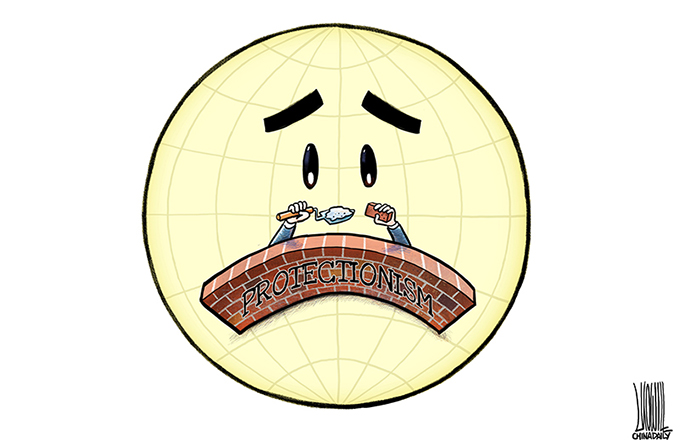
We should work to establish a balanced, inclusive and win-win multilateral trading system, continue to promote trade and investment liberalization and facilitation, remove trade barriers, and oppose and reject protectionism in all manifestations. We should support efforts by international institutions to strengthen supervision over trade and investment restrictions and advocate the inclusiveness and openness of bilateral and multilateral trade arrangements. We should work for early, comprehensive and balanced outcomes in the WTO Doha Round of negotiations and jointly foster a free, open, fair and equitable global trading environment and trading regime so that people of all countries may share the benefits of free trade.
We should vigorously promote international cooperation in development, and push for the shaping of a new type of global development partnership that is more equal and more balanced. We should support the important role of the United Nations and its specialized agencies in international development cooperation, and bolster the development functions of the World Bank and other international institutions in order to lay a solid institutional foundation for international development cooperation, and support developing countries in achieving the UN's Millennium Development Goals. We should follow through on the outcomes of the UN Conference on Sustainable Development, promote the establishment of the post-2015 development agenda, uphold the principle of "common but differentiated responsibilities", and agree on a new set of development goals that are straightforward, clear, balanced and practical.
The international community should understand that countries must take the road toward sustainable development in light of their respective national conditions. They should support the efforts of various countries to introduce policies and measures to promote green development and strike a balance between economic development, social progress and environmental protection.
It is the goal and core task of stronger global economic governance to address the issue of development. Development is of overriding importance with more than a billion people in the world still living in abject poverty and battling hunger every day.
Being a developing country and a major emerging economy, China has played an active role in advocating, practising and promoting the concept of global governance. Since the beginning of the 21st century, China has taken an active role in global governance and has proposed new concepts of security, civilization and development. Since the outbreak of the international financial crisis in 2008, China has actively responded to the challenges, fully engaged in the G20's discussions on global governance, strengthened macroeconomic policy coordination with major countries, increased its contribution to the IMF, supported other developing countries to the best of its ability, actively participated in the Doha negotiations, promoted regional economic integration, and made its own contribution to the advance of global governance.
China will continue to pursue peace, development, cooperation and mutual benefit, promote equality, mutual trust, inclusiveness, mutual learning and mutually beneficial cooperation in international relations, and work with other countries to uphold international fairness and justice. It will become more actively involved in international affairs and play the role of a major responsible country. China will unswervingly follow the path of peaceful development and a win-win strategy of opening up, accommodate the legitimate concerns of others when pursuing its own interests, and promote common development of all countries when advancing its own development.
Developing countries are a new and dynamic force in global governance. The imbalance between the North and the South is the most serious imbalance in the world today. As the largest developing country, China will always be a reliable friend and sincere partner of other developing countries. China will strive to develop relations of long-term stability and sound growth with other major countries, and encourage countries in the world to uphold unity, expand cooperation, properly handle differences and work for mutual benefit in exercising global governance.
In short, China will continue to uphold the principle of balancing rights with obligations, play an active role in global economic governance, and promote the building of a more just and equitable international order.
The author is assistant minister of foreign affairs.
(China Daily 02/20/2013 page8)