Plain talk and people first style
A fresh leadership style has emerged to distinguish the newly elected leaders of China.
Elected at the 18th Party Congress in November and awaiting the completion of the leadership transition at the forthcoming annual sessions of the National People's Congress and the Chinese People's Political Consultative Congress in early March, the new leadership, headed by Xi jinping and Li Keqiang, has already projected, communicated, and even implemented a distinctly fresh style of governance.
A new benchmark for good governance is being initiated for the decade ahead and beyond. China perceives this fact, and the worldwide press concurs.
Features of the new style are discernible from recent events. Here are some examples: The new "approachable, warm and confident" manner of the new leadership came through loud and clear when the new seven-member Standing Committee formally met the press for the first time after the 18th Party Congress. The leadership's vision for the future, now popularly known as the "China Dream," came from a statement Xi Jinping made during the Standing Committee's surprise visit to The Road Toward Renewal exhibition in Beijing. Xi said, "In my view, realizing the great renewal of the Chinese nation is the Chinese nation's greatest dream in modern history."
The leadership's preference for unadorned "practical work" emerged when Xi said during the visit that "making empty talk is harmful to the nation, while doing practical work can help it thrive". The eight measures for practical work that were subsequently formally adopted to improve the work of officials, require that they "have more contact with the people, conduct short meetings and make short speeches, and travel light with a small entourage without fanfare".
Xi Jinping's December trip to Guangdong, symbolically retracing Deng Xiaoping's 1992 southern inspection tour, exemplified the new work style. The trip was dignified and formal, but without fanfare, and conveyed the important yet simple message that reform and opening-up must continue.
In international relations Xi reiterated at a recent meeting with foreign experts working in China that China's unwavering goal is to make a greater contribution to world peace and development. But Xi has made it clear that "there should be no expectation that China will trade its core national interests" for anything.
Through plain talk and low-profile activities, the new leadership style is being subtly yet clearly conveyed. The new style stresses close bonds with the people, especially with the poor and the disadvantaged. The new style also focuses on fighting corruption, misuse of power, wastefulness, official pretentiousness, nepotism, and all types of empty and unproductive official formalism. The new style affirms efficiency, frugality, honesty, openness, inclusiveness, and self-generated industriousness.
The world admires China for its strong government leadership and for its people-first policies; both have ancient cultural and philosophical roots. The new leadership is continuing this tradition by embracing new opportunities and meeting new challenges.
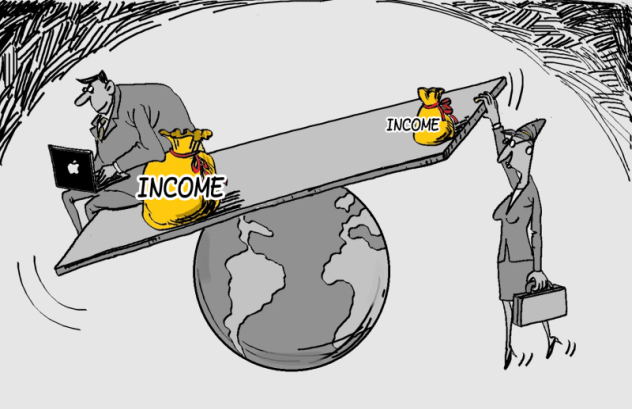
Putting the people first means seeking a good life for everyone. China's spectacular economic growth during the past 30 years was made possible by allowing some people to become rich first. By going all out for export-oriented, GDP-only development, China accumulated enough wealth to lift millions out of poverty (those who became rich first). However, despite this welcome progress, per capita GDP remains unacceptably low and the wealth gap is widening (millions are still poor).
The export-oriented, GDP-only development created, without intent, widening income gaps, widening rural and urban gaps, uneven social development, uneven distribution of resources and opportunities, unwarranted concentration of power in individuals and groups, laxity in supervision, pockets of social injustice, a decline in traditional social values, and other social and economic ills. All these are the natural results of the normal working of economic laws, or, as some would have it, the necessary evils of a market-driven economy. In any case, when new challenges are created, new solutions must be sought.
The challenges are real. China's chosen solution is to realize the ancient ideal of a xiaokang, a moderately prosperous society by 2020. This means making the largest pie possible and dividing the pie equitably.
To make the largest pie possible, China is switching to domestic (or import)-oriented GDP per capita economic development. To develop the means and the will to divide the pie equitably, the new leadership is improving the quality of civil society.
Strong government leadership requires talented people. Talented people in China are always developed through practical work, or on-the-job training. Leaders like Xi Jinping and Li keqiang typically started their careers as "educated youths", rising from being poor-village Party chiefs to where they are now today. This is leadership development, China style.
A new crop of future leaders is being developed this way. Today there are tens of thousands of college graduates who voluntarily work as village Party chiefs in poor areas. We do not hear much about them because their choice is normal and typical for young people with public service aspirations.
We do hear from the media about atypical cases. In 2011 Qin Yuefei, a media-shy 27-year old from Chongqing, who is a graduate of Yale University, decided to enter public service as an entry-level assistant in poor-remote Hejiashan village in Hunan province. Thus far he has raised 800,000 yuan ($127,350) for the village, procured 700 tablet computers for students, and through a Yale-alumni connection received a nursing home blueprint from a design company for free. Villagers fondly call him "Brother Yale." He is working hard and learning fast to become a village Party chief someday.
That Qin Yufei is a "Yalie" is interesting, but not significant. What is significant is the fact that he, like thousands of young people like him, was inspired to enter public service, China style.
This is the new and future China style of leadership.
The author teaches philosophy at Montclair State University, the United States.
(China Daily 02/25/2013 page9)