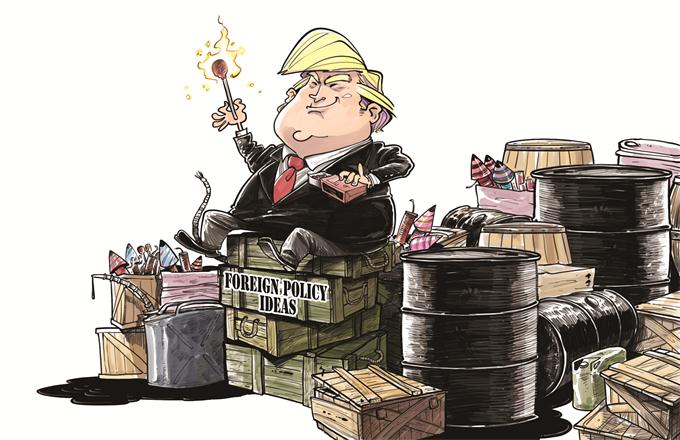
Tighter squeeze needed
To bring down house prices, measures required to reduce local governments' dependence on the property sector
The State Council announced recently that the policies and measures introduced to cool the housing market still have to be strictly followed. A release by the State Council after an executive meeting a week ago reaffirmed curbs on the purchase of residential housing for investment purposes and expanded the scope of the property tax being piloted in Shanghai and Chongqing.
The renewed tightening measures are directly related to the developments in China's housing market over the past year. Since the adoption of a new round of regulatory measures in early 2010 the housing market has experienced some enormous changes, with the frenetic price rises being effectively checked following the launch of the strict administrative measures.
Under these "strictest-ever" regulations, ranging from higher minimum down payments and higher interest rates for second-home mortgages to a ban on the buying of properties by non-local residents, speculation in the real estate market has almost vanished and demand for accommodation dominates the market. However, despite all of this, house prices remain at a stubbornly high level, far beyond the purchasing power of ordinary workers.
And worse, house prices have been rising in an increasing number of cities throughout the country since the latter half of last year, as indicated by the monthly data released by the National Bureau of Statistics, which tracks prices in 70 major cities. The continuing price rises have once again defied expectations that house prices would be on a downward trajectory after the implementation of the government regulations.
Instead, expectations that prices will continue to rise dominate the market. The sharp rise in home sales is a worrisome sign that many potential homebuyers have entered the market ahead of schedule because they anticipated the country's latest round of tightening policies would be relaxed or come to an end. However, such expectations have been dashed by the reaffirmation of established housing regulations by the central government. On the same day as the State Council meeting, Standard & Poor's, a popular international rating agency, changed the outlook for China's housing market from negative to stable, signaling that China's housing market is warming and the Chinese government faces a tough challenge taming house prices.
The State Council introduced no sharper new measures, it simply reaffirmed the established policies and measures that have not been enforced in some regions. This is an indication the government has few options available to it.
However, the meeting still sent an unequivocal message to the speculation-prone housing market that the government will not suspend its years-long housing regulations. This will undoubtedly help ease the anxiety of potential homebuyers that the regulations might be relaxed and thus alleviate some of the demand pressure pushing up prices.
It is unrealistic to pin too much hope on the reaffirmed regulatory measures to completely correct China's housing market. Over the past three years, the central government has been concentrating its energy on taming soaring house prices, to little effect. This is, to some extent, a reflection of the inability of the current regulatory measures to lower prices and thus highlights the need for the government to launch more forcible measures to curb any reviving investment and speculation in the market.
That real estate is the main engine of local economic development and a main source of local governments' fiscal revenues has offered fertile soil for speculation and corruption to flourish, as shown by media reports revealing the multiple houses owned by corrupt officials across the country. In the absence of an effective restraint mechanism on administrative power, the presence of the economic interests of local governments in the housing market has nurtured speculation and corruption. This has led to the common marketized means of reducing speculation, ranging from raising the minimal down payment requirement and higher interest rates for mortgages to restricting the use of public housing funds, failing to have the expected results.
As a way of taming the stubbornly high house prices, the central government should introduce better-tailored measures to restrain local governments' excessive dependence on the property sector.
The author is an economics commentator based in Shanghai.
(China Daily 03/01/2013 page8)