Funerals a death blow to the living
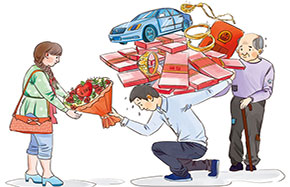
Come Qingming Festival (Tomb Sweeping Festival), and the media start highlighting how expensive funeral services have become in recent years. In fact, "it's too expensive to die" has become a standard joke to indicate the extravagant profits the mortuary industry makes.
People have the right to be sensitive about the rising cost of funeral services because it is a reality that no family can escape. But the fact is, people themselves could be blamed for the high cost of funeral services.
To begin with, the authorities in charge of funeral affairs don't agree that funeral services are expensive. At a press conference during the annual sessions of the NPC and CPPCC in March, Minister of Civil Affairs Li Liguo said the cost of basic funeral services, including transportation and refrigeration of the body, cremation and ash collection, is relatively low because the government has been subsidizing it for years. In most parts of China, basic funeral services generally cost between 1,000 yuan ($161) and 2,000 yuan. Besides, the government promotes free basic funeral service across the country.
The high cost that people complain about can be attributed to optional funeral services, which a family chooses according to its social and economic status. Although some supervision loopholes may allow some mortuaries to charge very high amounts for funeral services, in most cases families spend most of their money on purchasing tombs.
"Sky-high" tomb prices are not uncommon. In today's market-oriented society, it's the law of supply and demand that mainly determines tomb prices. Limited land resources and the ever-growing demand for tombs have pushed up prices. And as China's population ages, the imbalance between supply and demand will become more serious, making it even more difficult to reduce tomb prices to a level affordable for everyone.
The government wants to replace traditional interment with ecological burials such as burial at sea and "tree-burial", which will not only solve the high tomb-price problem, but also be environmentally friendly. But not many people are willing to accept them. The cost of "ecological burials" is rather low, but a majority of the people still prefer purchasing an expensive tomb for their departed relatives.
In Suzhou, Jiangsu province, for example, an average 1-square-meter grave costs 40,000 to 50,000 yuan, which is much higher than the local housing price. But in 2012 only several hundred families choose "ecological burials" for their departed relatives, although more than 15,000 remains are cremated in Suzhou every year.
Just as Vice-Minister of Civil Affairs Dou Yupei said, funeral services reflect the psychology of consumption. Traditional and psychological demand, not money, plays the most important role in funerals, indicating that the problem is difficult to solve by just following market rules. That's why despite the government's efforts to promote land-saving and environmentally friendly burials, high funeral services costs continue to plague the public.
Social recognition and filial piety are the two main psychological factors that deter people from accepting new forms of burial. In a society that accords high priority to social relationships, people use funeral services as a ceremony to gain public recognition. Many choose expensive traditional funeral services under psychological pressure or to "save face". And since filial piety is rooted deep in Chinese society, some people spend as much money as possible on funerals to ease their pain of losing a beloved one. Still others equate extravagant funeral services and luxurious tombs with the expression of filial piety.
Admittedly, tradition and ingrained ideas are rather difficult to change. But that doesn't mean society cannot do anything about it. Besides ensuring that low-income families' basic needs are met when it comes to funerals, the authorities can also enact policies to promote a standardized funeral procedure and discourage extravagant funeral services by imposing restrictions on the area of land that a family can purchase for a tomb.
More importantly, the concept of filial piety needs a rethink. The amount of money spent by children on their parents' funeral should not be used as the criterion to judge their filial piety. Children should take proper care of their parents' economic, emotional and spiritual needs when they are alive, rather than spending lavishly on their funerals to make a public show of their filial piety.
The author is a writer with China Daily.
E-mail: wangyiqing@chinadaily.com.cn.
(China Daily 04/03/2013 page9)