Today's kids need e-literate parents
The other day, I visited my cousin and was amazed to find how skilful her 6-year-old son was with an iPad, which he got as a birthday gift. His strategic thinking was on full display when he was playing "Cut the Rope".
As if that was not enough of a surprise, I learned that he uses the iPad as an audio-visual recorder to keep a weekly diary of the family with the help of his mother, who also helps edit the materials with iMovie.
Playing with touch-screen gadgets has become a rage among Chinese children. Unlike TV sets, a square box that sits on a table (or hangs from a wall), smartphones and tablets given their multi-functional qualities and portability are becoming part of an increasing number of urban children's lives. Their applications range from "Monster Morning", an app simulating morning routines for preschool kids, and "Toca House", whose lovable characters turn household chores into fun, to "Goodnight Moon", used for bedtime reading.
Several primary and secondary schools in cities such as Beijing and Shanghai are introducing pilot teaching programs with iPads as e-textbooks and exploring new ways of interactions in class.
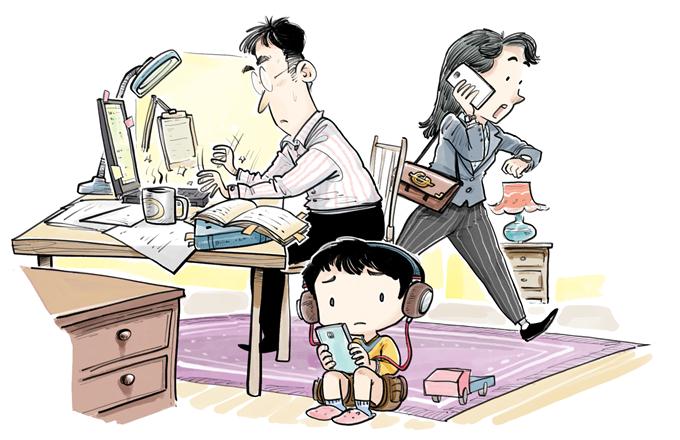
All this is exciting news. But wait. The flip side is that e-gadgets could harm children's mental and physical development, resulting in addiction and damage to their eyesight.
The media recently reported that a two-and-half-year-old child was diagnosed with myopia of minus 5.00 diopters because he used to be glued to an iPad. The mother now curses herself for giving her iPad to the child to keep it occupied. This, however, is not the only case of its kind. Many parents can be seen handing their smartphones or tablets to restless toddlers at dinners or during conversations to keep them quiet.
Last week, the National Health and Family Planning Commission of China issued a set of guidelines, recommending that children below two years should be completely "screen-free", meaning they should not be allowed to watch TV or play games on smartphones, tablets or laptops. And children up to six years should not spend more than an hour a day in front of screens, with a session not being more than 20 minutes. Moreover, parents should not use iPad as a pacifier or an electronic babysitter.
Lisa Guernsey, author of Screen Time, uses three Cs - content, context and your child - to deal with questions on children's screen time. Based on her theory, a few questions should be asked when it comes to children playing on e-gadgets. Is the content appropriate? Is the child playing on iPad for half an hour and then going for outdoor activities, or is it only hunched over iPad? Does the screen time take up a small part of the child's larger interaction with the real world? And do you understand the unique quality of your child and keep track of its interests?
It's been only about three years since users could access the Internet on iPad-like tablets and, hence, the effects of such interactive screen devices on children's neurological and cognitive development are not yet known. But a two-decade-long research, highlighted in The Guardian, says there is a strong correlation between mental stimulation in early childhood and more developed cerebral cortex in late teens. Scientists found that the more mental stimulation a child undergoes around the age of four, the more enhanced its language and cognitive skills will be in later decades.
Some people forbid children from using such devices because they are afraid that it could lead to addiction. Some others introduce children to fancy apps thinking they will make them smarter. The need is to strike the right balance between the two.
It is important for young parents, especially those in cities, to be e-literate because they have to guide their children through the maze of technology that society has become today. Parents have to take a balanced view of the time children spend with gadgets by setting specific timings, apps and rules for them.
When I grew up in the late 1980s and early 1990s, screen time simply meant watching television, which has been blamed for a host of maladies, from screen addiction to obesity among children over the past 20 years. But Sergeant Black Cat and Chi-bi Maruko remain part of nostalgia for many people who grew up in those times. As with any medium, TV or e-gadgets can be good and bad, depending on how they are used. Nevertheless, even if children enjoy their time with dolphins or playing soccer on a tablet screen, there is nothing to stop their parents from taking them to a zoo or aquarium, or sending them to a playground for a real life experience.
The author is a reporter with China Daily.
E-mail: dongfangyu@chinadaily.com.cn.
(China Daily 04/25/2013 page9)