Pros and cons of rising labor costs
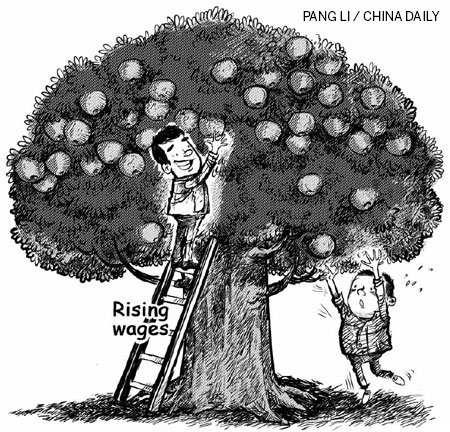
Rising wages and slowing productivity, coupled with declining demographic dividends, have stirred concerns that China's competitiveness in manufacturing is eroding. Structural changes are certainly taking place, notably in the cheap labor segment, shifting dynamics along the value chain and across provinces. These changes, however, are positive in terms of the strived-for shift in China's economic growth model.
China's working-age population (based on the Chinese definition of people between the ages of 15 and 59) fell by almost 3.5 million in 2012. This striking demographic development threw into sharp relief the limits of China's growth model of the past three decades.
Structural changes in the labor market actually started a few years ago. Wages in the manufacturing sector increased significantly while labor productivity started slowing. Some observers and investors interpret these developments as a serious erosion of China's cost competitiveness.
Indeed, since China's entry into the World Trade Organization in 2001, real wages paid in the manufacturing sector have risen by almost 200 percent in US dollar terms, surpassing the rate in Thailand and closing the gap with the Philippines. Strikingly, wages in China continued to increase during the 2009-11 period, even as other countries in the region felt the dampening impact of the global financial crisis.
Until recently, wage increases went along with rapid labor productivity gains. Surplus labor absorbed by the non-agricultural sector led to rapid improvements in output per person employed, lifting China's labor productivity level above those of Indonesia and the Philippines within a decade. Nevertheless, China's real GDP per worker remains below Thailand's and Malaysia's, not to mention South Korea's. And over the last couple of years, labor productivity growth has started to slow down.
In 2012, China's productivity grew the least since 1999 (although it outpaced the rest of Asia). Worryingly, a similar slowdown was observed in total factor productivity, which takes into account efficiency gains such as managerial competence and technology diffusion. As a result of these developments, China's unit labor costs (ULCs) - the ratio of wages to real output per person employed - trended up considerably in 2011-12, to a larger extent than for example in ASEAN economies.