Negative to positive energy
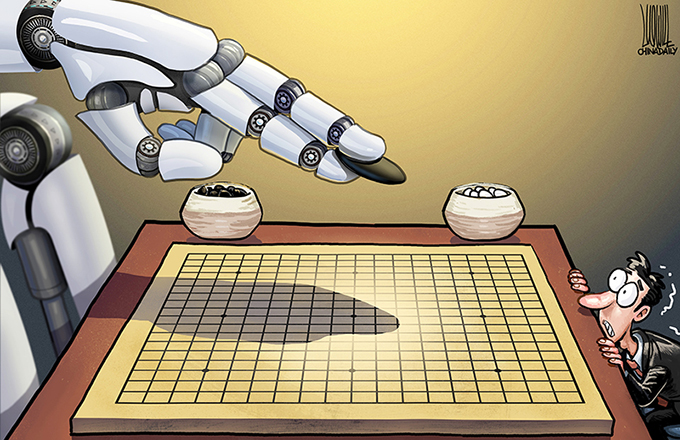
Although China is the "weaker" and "aggrieved" party when it comes to bilateral military interactions, the US has always seen it as the "guilty" party. Apart from criticizing China's "opaque" military budget, the US has made an issue out of China's efforts to develop its navy. Recently, the US made a hue and cry over cyber-attacks allegedly launched by China on American government and business websites. It seems that some US interest groups have mastered the art of exaggerating China's military threat to advance their political goals.
That's why when Xi and Obama meet in California and draw a blueprint for interactions between the two countries, they cannot afford to ignore security and military relations. They have to take the bull by the horns and turn "negative energy" into "positive energy".
In the past, conflicting Sino-US security interests have received undue importance while their common security interests have been ignored. It is in two countries' interests to maintain regional peace, stability, security and prosperity. More importantly, their conflicting security interests can be turned into opportunities, which the two powers can pursue for mutual benefit.
For example, curbing "Taiwan independence" a few years ago and preventing a military conflict between China and Japan over the Diaoyu Islands recently were in the common security interests of China and the US, for an armed conflict in the region would inevitably drag China and the US into a maelstrom.
Today's world is full of challenges, many of which need Sino-US cooperation to address. This not only has a direct bearing on a stable, healthy development of Sino-US relations, but also on the stability and security in East Asia and the Asia-Pacific region as a whole. To break the "security dilemma" of Sino-US relations, the two countries should handle their relationship through "mutual adaptation" and "mutual concern".
The US should abandon its Cold War mentality and "Air-Sea Power" concept, and cease to view the modernization of China's military, particularly its navy, as a threat to its security. By abandoning its zero-sum thinking and becoming open to the concept of cooperative security to jointly address security challenges, the US will not only pave the way for healthy military ties with China, but also will create an atmosphere for the healthy development of overall Sino-US relations.
China, on its part, should promote a harmonious world and peaceful development, and never seek hegemony. An important way to break the Sino-US "security dilemma" is to improve the two countries' strategic communication.
Moreover, the two sides must properly handle "third-party factors". Some disputes over territorial and maritime rights and interests between China and some of its neighbors remain unresolved. China should firmly safeguard its national interests but, at the same time, it should also try to resolve the disputes through peaceful and diplomatic means. The problem is that some countries are trying to get the US involved in their disputes with China, which will complicate things further.
As long as China and the US are willing to strengthen cooperation and avoid playing a zero-sum game, there is great potential for Sino-US military cooperation, especially against non-traditional security threats. This can also help strengthen strategic trust between the two countries' militaries, eliminate misunderstandings and prevent strategic misjudgments.
There is every reason to believe that with concerted efforts, China and the US can bid adieu to the zero-sum game and play the leading role in building a harmonious world.
It is especially in this context that the upcoming Sino-US summit presents a great opportunity for the two countries' leaders to promote bilateral relations, especially military relations, for a better and more secure future.
The author is a rear admiral and former director of the Institute for Strategic Studies at the People's Liberation Army National Defense University.
(China Daily 06/04/2013 page9)