China's long march in space
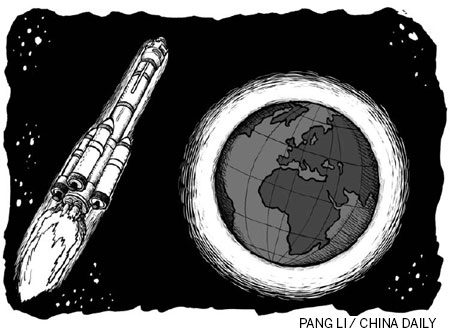
The Shenzhou X spacecraft, with three astronauts on board, blasted off from Jiuquan Satellite Launch Center in Gansu province and entered its designated orbit on Tuesday. At noon on Thursday, it successfully docked with the Tiangong-1, a target orbiter and space module.
The latest launch, China's fifth manned mission within just 10 years of its first such mission into space, demonstrates the country's steady progress in manned space operations. The smooth launch also ushers in the first application-oriented flight of the Shenzhou spacecraft, which was preceded by years of both unmanned and manned test spaceflights since 1999.
Shenzhou X and the upgraded Long March-2F carrier rocket constitute China's Earth-to-space transport system, which can ferry astronauts and supplies between Earth and the in-orbit Tiangong-1 space module and support scientific experiments in the target orbiter.
As such, there are no drastic changes in Shenzhou X in the technical sense, except for a few adjustments from Shenzhou IX, which include upgraded internal environmental control and life support system. Still, Shenzhou X marks a giant leap in China's space program, because it provides technological guarantee for assembling a space station in orbit, which holds great significance for a rising space-faring nation like China.
As is well known, the United States and Russia agreed to join their space station efforts in 1993. Since 1998, they have also been collaborating with other major powers, including Japan and 10 member states of the European Space Agency, in the International Space Station program.
The US, however, has played a pivotal role in preventing China from participating in the so-called family of space-faring nations. Washington issued the Cox Report in 1999, which accuses China of nuclear spying and stealing military technology from the US. The report and the National Defense Authorization Act for Fiscal Year 1999, which prohibits exports of US-origin satellites, missile equipment and other related technologies to China, rule out the possibility of space cooperation between China and the US.
Despite the US straight-arming China from joining the ISS program, Beijing's space mission continues to thrive, and the successful launch of Shenzhou X shows that it has moved one step closer to building its own space station by 2020.
China is the third country to independently send humans into space and conduct extra-vehicular activities. It is now one of the top countries in overall space prowess. And its homegrown navigation satellite system Beidou aims to grab 70-80 percent of the domestic market share from GPS and is expected to achieve full-scale global coverage possibly by 2020.