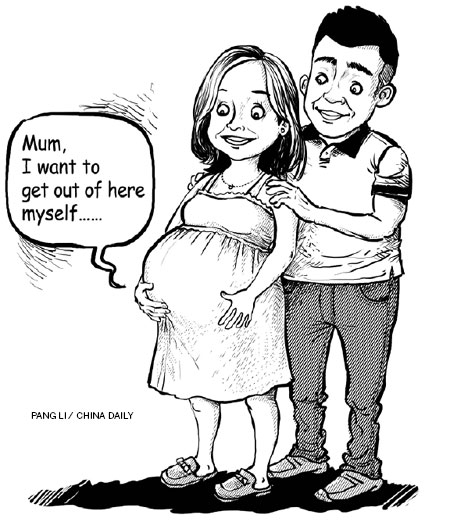
The birth of a son for Duchess of Cambridge Kate Middleton and Prince William - through natural birth procedure - is a good opportunity to ponder on the high number of Caesarean births (C-sections) in China. The situation has reached epidemic proportions, and some of its serious consequences should make Chinese women think twice before requesting this procedure. Today, China has one of the highest rates of C-sections in the world, estimated at 50 percent, a quarter of which are not necessary, according to the World Health Organization surveys.
The view that a woman has the right to make decisions regarding her body and her health has led many women to choose the method of delivery. In fact, throughout the world, an increasing number of women have been demanding to give birth through C-section.
"Cesarean delivery on maternal request" is a movement that may have started in Brazil, a country with one of the highest number of C-section rates. The use of this procedure, however, carries some health risks, warns WHO, which doesn't see the advantages of the shift from natural birth to Cesarean birth.
In a survey of nine Asian nations, WHO found that unnecessary C-sections are costlier than natural births and raise the risk of complications for the mother. Many experts say natural birth is the ideal method of delivery. "The relative safety of the operation leads people to think it is as safe as vaginal birth," said A. Metin Gulmezoglu, who co-authored the Asia report, "but that's unlikely to be the case."
WHO, which reviewed nearly 100,000 births across Asia in 2007-2008, found that 27 percent was through C-section, apparently motivated by mothers' request and hospitals' eagerness to make bigger profits. Slightly higher results were reported by WHO in a study conducted in 2005 in Latin America - 35 percent of the women surveyed had delivered their babies through C-section. In Europe, there are big differences among countries. While in Italy the C-section rate is 40 percent, in the Nordic countries it is only 14 percent.
There are several reasons why women in Asia prefer to have their babies through C-section. Many of them fear the pain during delivery or worry that their vaginas may be stretched or damaged by a normal delivery. Others, however, believe that this procedure is less risky for the mother. Also, some women choose C-section so that they could give birth on the day or time "prescribed" by a fortuneteller to bring "luck" on the child.
Many experts in Latin America have warned about the abuse of the C-section, particularly in countries such as Brazil, where it has reached extremely high levels. Many expectant mothers in Latin America even schedule their surgery to avoid going into labor on special holidays and in some cases just to attend a party.
Hospitals' greed for profit may also be behind the abuse of C-section. For example, in China's larger cities, the cost of undergoing a C-section can be twice as much as that for natural delivery. According to the WHO study, 62 percent of the surveyed hospitals in Asia reported having a financial interest in performing C-sections.
In China, the abuse of C-section may create some problems related to the healthcare delivery system. For example, they may provoke an increased demand for hospital beds, anesthesiologists, operating theaters and laboratory and blood transfusion facilities to the detriment of more serious cases.
In addition, a study published in Obstetrics and Gynecology found that women who had undergone several C-sections were more likely to have problems with later pregnancies.
According to some experts, the introduction of the strict family planning policy in the late 1970s might have indirectly contributed to the increasing use of this technique. They claim that the risk of C-section is lower for women who expect to have only one child and, hence, they choose it believing it to be the safest method of giving birth. However, very little is known about the safety of C-section in China, in spite of the fact that such information is much needed.
More studies are needed to understand why so many Chinese women are choosing to undergo C-section. Also needed is an analysis of C-section's consequences on the health of the mother and the child, and the promotion of midwifery-led maternity care models that emphasize natural birth.
The author is an international public health consultant and has the book, Maternal Health, to his credit.
(China Daily 07/24/2013 page9)
 New type of urbanization is in the details

Copyright 1995 - . All rights reserved. The content (including but not limited to text, photo, multimedia information, etc) published in this site belongs to China Daily Information Co (CDIC). Without written authorization from CDIC, such content shall not be republished or used in any form. Note: Browsers with 1024*768 or higher resolution are suggested for this site.
License for publishing multimedia online 0108263 Registration Number: 130349