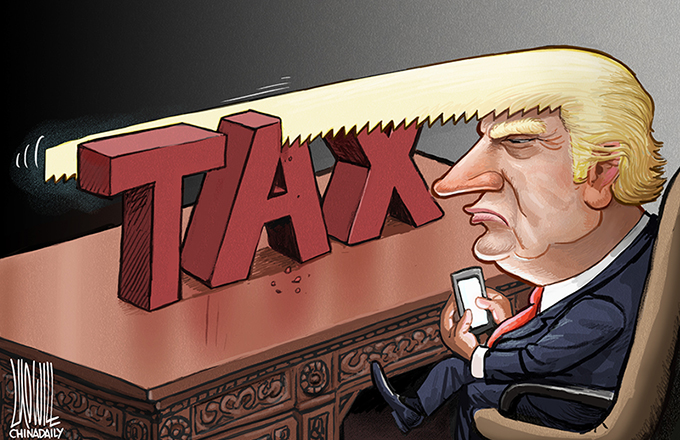
Overcapacity obsession
The market rather than the government should determine which iron and steel enterprises are to close down
The elimination of iron and steel overproduction has been a key part of a campaign the government launched in 2010 to promote its long-overdue industrial structural adjustment.
That the government decides which steel enterprises will be retained and which are to be closed down shows that China still uses administrative means to decide the fate of its steel enterprises.
But what are the effects of this?
According to recent data from the China Iron and Steel Association, from 2006 to 2012, China reduced 76 million tons of crude steel production much less than the additional 440 million tons of crude steel manufactured during the same period. As the construction of some iron and steel enterprises is still under way, China is expected to witness an additional 110 million tons of iron production and 130 million tons of steel production over the next three years.
The government should reflect on the use of administrative means to reduce overcapacity in the iron and steel sector, as it simply results in "the more measures, the greater the capacity". Instead, it should let market mechanisms break what has become a vicious circle.
From the perspective of market competition, some overcapacity is not inevitably a bad thing, given that moderate overproduction will not only increase the pressure on enterprises to introduce technological innovations, it will also provide the motivation for industrial upgrading. With excessive capacity in the market, all enterprises will have to promote technological innovations and structural upgrading to ensure that they can improve the quality of their products or develop new products to sharpen their competitiveness edge and raise their return ratio.
According to data published by the United States Federal Reserve, the rate of industrial capacity utilization in the US was 74.2 percent in 2008 and its industrial capacity increased by 40.7 percent from 2002 to 2008. However, its actual industrial production increased by just 4.4 percent during the same period.
In comparison, China's actual steel manufacturing capacity was 976 million tons by the end of 2012, compared with its actual crude steel production of 731 million tons, a 74.9 percent rate of capacity utilization. These indicate that the US' industrial excess capacity during the global financial crisis was even more prominent than it is in China today.
A moderate degree of overcapacity is not a cause for concern. But, compared with the government, the market is more sensitive to where the overcapacity line lies. It has become common in China for the government to put a strict ban on the start of new projects and work out a list of enterprises to close down in order to reduce overcapacity. However, the imposition of an indiscriminate ban on new projects will possibly restrict the entry of new technologies.
Since 2010, the Ministry of Industry and Information Technology has published several lists of enterprises that are to be eliminated in the power, coal, steel, non-ferrous metals and textile sectors. However, the standards for their elimination are mainly based on whether they are big energy consumers and polluters, or whether they are below a given scale. Eliminating polluting enterprises and those that consume a lot of energy is understandable and desirable, but the elimination of enterprises based on scale is open to discussion, as a small production scale does not inevitably mean low technological and management levels.
Some local governments, because they want to expand the local gross domestic product to project their performance, make enterprises bigger in order to prevent them from being closed down because the central government deems them too small. As a result, those enterprises with overcapacity prefer to ponder how to expand their scale rather than working hard for industrial upgrading. These remain the biggest obstacle to the market-based reduction of overcapacity. International practices also indicate that the use of administrative means to deal with overcapacity will not have any substantial effect.
To increase or reduce excess capacity, market-based means are desperately needed, such as mergers or reorganization among the enterprises themselves, to let those with a sharp edge thrive and drive out the less competitive ones.
What the government should do now is to create a good environment for market competition and give the market a bigger role in the distribution of resources and the national structural adjustments. It should refrain from acting as a judge to decide which enterprises should be eliminated and which ones retained.
Zhao Xiao is a professor and Chen Jinbao a researcher at the School of Economics and Management, Beijing University of Science and Technology.
(China Daily 08/19/2013 page8)